Volunteer Induction: How to Welcome Volunteers and Keep Records Organised
Volunteers give their time, energy and skills to organisations that often depend on goodwill, trust and community support. They may help at events, support charities, assist schools, work with sporting clubs, join community projects, serve on committees, help with fundraising or support not-for-profit services.
Because volunteers are generous with their time, it can be tempting to keep the onboarding process informal. A coordinator may explain the basics, introduce a few people and ask the volunteer to start helping straight away.
That approach may feel friendly, but it can leave important gaps.
A volunteer induction gives every new volunteer a clear and consistent introduction to the organisation, the role, the people, the risks and the expectations. It helps volunteers feel welcome while also helping the organisation protect people, explain responsibilities, keep records and reduce avoidable confusion.
A structured online induction process can make this easier, especially when volunteers are spread across sites, events, rosters, community programs or short-term projects. Instead of repeating the same introduction manually, organisations can provide the core information online, collect forms, request acknowledgements and keep completion records in one place.
Why volunteer induction matters
Volunteer induction is not only about administration. It is about respect, clarity and safety.
A new volunteer should understand why the organisation exists, what their role involves, who they report to, where they can ask questions and what standards apply. They should also understand basic safety expectations, emergency procedures, confidentiality requirements, behaviour standards and any limits on what they are allowed to do.
When this information is missing, volunteers may feel uncertain. They might not know who to approach for help. Some may take on tasks outside their role, while others may miss safety instructions or misunderstand privacy expectations.
In some cases, confusion can lead to incidents, complaints, poor service or unnecessary stress.
A good volunteer induction helps avoid those problems by giving people a reliable starting point. It also sends an important message: volunteers are valued enough to be properly welcomed and properly supported.
Volunteer induction is different from employee onboarding
Volunteers are not always managed in the same way as paid employees. They may work fewer hours, attend irregularly, help at events, support short-term projects or contribute from different locations.
Some volunteers may be highly experienced. Others may be completely new to the type of work being performed.
That mix makes volunteer onboarding especially important.
Paid employees often receive structured onboarding through HR, payroll, manager briefings and role-specific processes. Volunteers may not pass through the same formal channels, so key information can easily be missed unless the organisation has a clear induction pathway.
A volunteer induction should be practical, respectful and easy to complete. It should not feel like unnecessary bureaucracy. However, it should still give the organisation confidence that important information has been shared, forms have been completed and expectations have been acknowledged.
For organisations that also onboard paid workers, the broader principles behind employee onboarding software can help shape a more consistent approach, while the volunteer pathway can stay lighter, friendlier and suited to unpaid roles.
What a volunteer induction should include
A useful volunteer induction should explain the organisation, the role and the working environment in plain language.
The exact content will depend on the organisation, but a volunteer induction kit often includes:
- welcome message and organisation overview
- purpose, values and community role
- volunteer role description
- supervisor or coordinator contact details
- arrival, sign-in and attendance procedures
- expected behaviour and code of conduct
- health and safety instructions
- emergency and evacuation information
- incident and hazard reporting steps
- confidentiality and privacy expectations
- child safety or vulnerable person requirements where relevant
- dress code or identification requirements
- use of equipment, vehicles or facilities
- reimbursement or expense procedures where applicable
- complaints and escalation pathways
- policy acknowledgements and digital forms
- completion confirmation or certificate
The aim is not to overwhelm the volunteer. The goal is to provide enough information for them to begin with confidence and know where to get help.
A simple online training structure can also help organisations turn existing volunteer handbooks, policies, videos and forms into a more organised induction pathway.
A welcoming introduction builds confidence
The first part of volunteer induction should make people feel welcome.
Volunteers often join because they care about a cause, community, organisation or event. A cold, overly formal process can weaken that enthusiasm. A thoughtful introduction can do the opposite.
A good welcome explains the organisation’s purpose, the impact volunteers make and how the new person fits into the wider team. It may include a message from a coordinator, a short video, a brief history, photographs of the work being done or a simple outline of the organisation’s values.
This is where volunteer induction should feel human.
People are more likely to stay engaged when they understand why their contribution matters. They are also more likely to ask questions, report concerns and follow procedures when they feel included from the beginning.
Role clarity prevents confusion
Volunteers need to know what they are expected to do and what they should not do.
This is especially important in organisations where volunteers work with clients, children, older people, people with disability, animals, vehicles, food, equipment, donations, public events or confidential information.
A volunteer role description may explain:
- tasks the volunteer may perform
- activities outside the volunteer’s role
- who supervises the work
- when and where the person should attend
- what equipment or systems they may use
- how to report problems
- when to ask for help
- how to end a shift or sign out
Clear boundaries protect both the volunteer and the organisation.
They also help coordinators manage expectations. A volunteer who understands the role is less likely to feel anxious, overstep boundaries or be placed in a situation they are not prepared for.

Safety information should be simple and practical
Volunteer safety induction should focus on the hazards and procedures that matter for the role.
A person helping at a fundraising desk needs different information from someone setting up marquees, driving a vehicle, preparing food, working with children, supporting an aged care program or helping at a sporting event.
Useful safety content may include:
- emergency exits and assembly points
- first aid arrangements
- hazard reporting
- incident reporting
- manual handling basics
- slips, trips and falls
- safe use of equipment
- working alone or after hours
- weather exposure
- personal protective equipment where required
- safe driving or transport rules
- hygiene and infection control where relevant
- aggression or difficult behaviour procedures
A broader guide to workplace health and safety can help organisations understand how these ideas connect to general WHS responsibilities.
The best safety instructions are clear enough for a volunteer to follow during real work, not just read once and forget.
WHS duties and volunteers
In Australia, volunteer organisations and volunteers may have work health and safety duties depending on the structure of the organisation and whether people are employed.
A volunteer organisation that employs workers will usually have WHS duties to both paid workers and unpaid volunteers. Volunteers may also have duties to take reasonable care for their own health and safety, avoid adversely affecting others and follow reasonable instructions, policies and procedures.
This makes volunteer induction more than a nice introduction.
It can help an organisation explain safe work expectations, provide practical information, collect acknowledgements and show that key instructions were given before work began.
The exact obligations can vary by state, territory and organisation type, so organisations should check current guidance from their relevant regulator. Still, as a practical matter, every organisation that engages volunteers benefits from a clear and consistent process.
Volunteer policies, conduct and acknowledgements
Volunteer induction should explain the behaviour standards that apply while volunteering.
That may include policies for bullying, harassment, discrimination, privacy, confidentiality, social media, child safety, vulnerable people, conflict of interest, complaints, gifts, workplace behaviour and use of organisation property.
Some policies may only need a short explanation. Others may require a formal acknowledgement.
Digital e-signatures can help organisations record that a volunteer has read and accepted important requirements. This is useful when policies apply across multiple sites, events or programs and administrators need a reliable record later.
Policy acknowledgements should not be treated as a substitute for genuine communication. They work best when the policy is written clearly, explained properly and supported by a contact person who can answer questions.
Volunteer forms and document collection
Many organisations need to collect information before a volunteer begins.
This may include emergency contact details, medical information relevant to the role, identity details, referee information, Working with Children Check details, police check details, licences, qualifications, vaccination records where relevant, vehicle information, signed declarations or other documents.
Manual collection can be messy.
Forms may be emailed to one person, stored in folders, printed for events or updated in spreadsheets. If a document expires, someone has to notice. When a coordinator changes roles, information can become harder to find.
A central document registry can help organisations keep important volunteer documents organised. For volunteers who also act as contractors, service providers or specialist workers, contractor pre-qualification can help collect and review required evidence before work begins.
Good document collection protects the organisation and helps coordinators understand who is ready to start.
Volunteer compliance records need to be easy to find
Volunteer compliance records matter because they show what was completed.
If a question arises later, the organisation may need to know when a volunteer completed induction, which documents were submitted, which policies were acknowledged, what role was assigned and whether any follow-up was required.
Good record keeping also helps coordinators improve the program over time. When volunteers repeatedly ask the same question, the induction content may need clearer wording. If incidents occur in the same activity, the procedure may need review. Where documents regularly expire without notice, the process may need better reminders.
Records should not be collected for their own sake. They should help the organisation manage people properly, respond to issues and keep a reliable history of what has happened.
A reporting process also helps coordinators and managers see completion status across teams, locations and events. With reporting, administrators can review progress, follow up missing steps and keep better visibility without searching through emails, folders and spreadsheets.
Visitor and volunteer sign-in
Volunteer programs often overlap with visitor management.
A volunteer may arrive at a school, charity office, community centre, hospital, aged care facility, club, event site, warehouse or public venue. The organisation may need to know who is onsite, when they arrived, where they are working and who is responsible for them.
A clear sign-in process supports safety, emergency management and accountability.
For some organisations, a simple visitor book may be enough. For others, a digital visitor management process can provide better visibility, especially where volunteers attend irregularly or arrive at multiple locations.
Sign-in should connect with the broader induction process. If a volunteer has completed the required induction and acknowledgements, coordinators should be able to confirm that status before the person begins work.
Incident and hazard reporting for volunteers
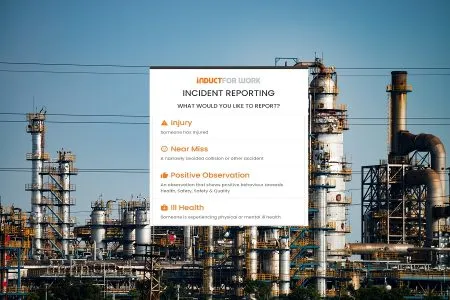
Volunteers need to know how to report hazards, incidents, near misses and concerns.
This should be explained early because many volunteers may hesitate to speak up. They may worry about causing trouble, making a mistake or being seen as difficult. A strong induction should make it clear that reporting concerns is expected and appreciated.
A simple incident reporting process helps volunteers and coordinators record what happened, assign follow-up and identify repeated issues.
Examples may include:
- slip hazards near event entrances
- aggressive behaviour from members of the public
- faulty equipment
- unsafe lifting
- damaged flooring
- illness or injury during a shift
- privacy or confidentiality concerns
- vehicle or transport incidents
- near misses during setup or pack-down
Reporting should be easy to understand. Volunteers should know who to contact immediately and how the issue will be followed up.
Volunteer induction for different organisation types
Volunteer induction should reflect the setting.
A charity shop may need information about donations, cash handling, customer behaviour, lifting boxes and opening procedures. A sporting club may need guidance on child safety, first aid, equipment storage, coaching boundaries and event setup. School volunteers may need information about sign-in, privacy, student safety and restricted areas.
Community service organisations may need to cover vulnerable clients, confidentiality, driving, home visits, infection control or personal safety. Environmental groups may need to explain outdoor hazards, weather exposure, tools, wildlife, remote work and communication procedures.
A not-for-profit with multiple services may need separate induction pathways for each program. The broader not-for-profit sector page explains how Induct For Work can support charities and community organisations with online inductions, sign-ins, incident reporting, documents and compliance records.
A single generic induction rarely suits every volunteer. The best process provides one common introduction, then adds role-specific content where needed.
Events and short-term volunteer programs
Events often rely on volunteers who may only assist for a few hours or days.
That creates a different challenge. Coordinators need to prepare volunteers quickly without skipping essential information.
An event volunteer induction may cover arrival time, parking, sign-in, wristbands or badges, emergency contacts, weather preparation, crowd management, radio use, first aid points, lost child procedures, food handling, manual handling, restricted areas and end-of-shift requirements.
Short-term volunteers still need clarity.
Online volunteer induction can help event organisers send the core information before the event. This reduces pressure on coordinators during setup and gives volunteers time to read instructions before the busiest part of the day.
Volunteer management across multiple sites
Many organisations manage volunteers across more than one place.
A charity may run several shops. A community organisation may have multiple programs. A council may coordinate volunteers across events, libraries, parks and support services. A school or aged care provider may need different pathways for regular volunteers, event helpers and visitors who assist occasionally.
Multi-site volunteer management becomes difficult when each location keeps its own forms, spreadsheets and informal notes.
A more organised system helps coordinators see who has completed induction, which documents are current, where a volunteer is assigned and whether any follow-up is required. This is where volunteer management software becomes valuable because it gives administrators one clearer place to check readiness and records.
The process does not need to be complicated. It simply needs to be consistent enough that people can rely on it.
Repeating the same briefing wastes coordinator time
Volunteer coordinators often work under pressure.
They may recruit volunteers, answer questions, organise rosters, run events, manage records, handle community enquiries, report to boards, support staff and solve last-minute problems. Repeating the same induction manually for every new person can take valuable time away from higher-value support.
A traditional face-to-face briefing still has value, especially for personal introductions and role-specific guidance. However, the repeatable parts of the induction can often be delivered online.
This means coordinators can spend more time welcoming people, answering specific questions and supporting volunteers in the field.
Online volunteer induction versus paper induction kits
Paper induction kits have been used for many years. They can still be useful when volunteers need a printed reference or when technology access is limited.
However, paper creates familiar problems.
Documents can become outdated. Signed forms can be lost. Coordinators may not know who has read the latest version. Volunteers may receive different information depending on who printed the pack. Records can sit in filing cabinets, email inboxes and spreadsheets.
Online volunteer induction gives organisations a more controlled process.
Content can be updated centrally. Forms can be completed digitally. Acknowledgements can be linked to the volunteer. Completion records can be checked by administrators. Volunteers can access the information before they arrive, which helps them feel more prepared.
Traditional personal support still matters. Online induction simply makes the repeatable administration easier to manage.
Supporting a stronger volunteer safety culture
A strong safety culture is built through behaviour, not slogans.
Volunteers notice how an organisation handles safety. They notice whether hazards are taken seriously, whether procedures are explained, whether coordinators respond to concerns and whether people are treated respectfully.
A clear volunteer induction helps set that standard early.
It shows that the organisation values volunteers enough to protect them properly. It also helps volunteers understand that safety, respect, confidentiality and accountability are part of the role, not optional extras.
A good culture does not make volunteering feel rigid. It makes people feel supported.
Fast setup for volunteer induction
Many organisations already have the material needed for a strong volunteer induction.
They may have volunteer handbooks, codes of conduct, safety procedures, emergency instructions, privacy policies, forms, position descriptions, site maps and event briefings. The challenge is often not creating everything from zero. The challenge is organising it into a clear process that people can complete.
Rapid induction setup can help move existing documents, videos, forms and instructions into a structured online pathway.
This is useful for organisations that need to improve quickly before an event, funding review, new volunteer intake, site opening, seasonal program or board reporting period.
How Induct For Work helps with volunteer induction
Induct For Work helps organisations create, send and track volunteer inductions online.
You can build induction content, invite volunteers, collect forms, request acknowledgements, issue certificates, store records and review progress from one system. The platform can also support visitor sign-in, incident reporting, document collection and reporting.
Induct For Work can help organisations:
- create volunteer induction courses
- invite volunteers by email or SMS
- collect emergency contact details
- request documents and declarations
- record digital signatures
- explain role expectations
- share safety procedures
- use quizzes where suitable
- issue completion certificates
- monitor completion status
- keep induction records organised
- support visitor or volunteer sign-in
- review reports when required
The aim is to reduce manual administration while still keeping the volunteer experience clear and welcoming.
Who this is for
This page is for organisations that rely on volunteers and need a better way to welcome, guide and record them.
It may suit:
- charities
- not-for-profit organisations
- community groups
- sporting clubs
- schools
- aged care providers
- healthcare support services
- churches and faith-based organisations
- environmental groups
- fundraising teams
- event organisers
- museums and galleries
- emergency support groups
- animal welfare groups
- local government volunteer programs
It is also useful for the people responsible for volunteer management.
Coordinators need less paperwork. Managers need clearer records. Board members need confidence that systems are in place. Supervisors need volunteers to understand boundaries and expectations. Volunteers need to feel prepared, supported and welcomed.
Start improving your volunteer induction process
A volunteer induction should be warm, clear and well organised.
It should help people understand the organisation, their role, the safety expectations, the behaviour standards and the support available to them. It should also help the organisation collect forms, record acknowledgements and keep evidence that the right information was provided.
If your current process depends on printed packs, repeated briefings, email attachments and spreadsheets, it may be time to move to a more reliable process.
Induct For Work gives organisations a practical way to deliver volunteer induction online while keeping records in one place.
That means fewer repeated explanations, fewer missing forms and better visibility over who is ready to begin. Volunteers receive a clearer start, coordinators save time and managers gain stronger records when questions arise later.
Start your 14-day free trial and see how Induct For Work can help your organisation welcome volunteers properly, reduce administration and keep clearer records.
Frequently asked questions
A volunteer induction is the process of welcoming a volunteer, explaining their role, sharing safety information, outlining behaviour expectations, collecting required forms and helping the person understand how the organisation works.
Volunteer induction helps people feel welcome, confident and prepared. It also helps organisations explain safety rules, clarify responsibilities, collect acknowledgements and keep records of what information was provided.
A volunteer induction kit may include an organisation overview, role description, safety rules, emergency procedures, code of conduct, contact details, privacy expectations, incident reporting steps, required forms and policy acknowledgements.
Online volunteer induction helps coordinators send consistent information, collect forms, request acknowledgements and check completion before a volunteer begins. This reduces repeated briefings and manual chasing.
Some volunteer organisations have WHS duties, especially where they also employ workers. Volunteers may also have duties to take reasonable care and follow reasonable instructions. Organisations should check current guidance for their jurisdiction and structure.
No. Volunteer induction can be used by charities, sporting clubs, schools, councils, community groups, events, healthcare support services, churches, museums, environmental groups and many other organisations that rely on volunteers.
Organisations may collect emergency contact details, declarations, policy acknowledgements, Working with Children Check details, licences, qualifications, referee details, medical information relevant to the role or other required documents.
No. Face-to-face support is still important for welcoming volunteers, answering questions and explaining role-specific tasks. Online induction supports that process by handling the repeatable information and record keeping.
Yes. Organisations can create different induction pathways for event volunteers, office volunteers, drivers, committee members, school volunteers, charity shop volunteers or other role groups.
Volunteer induction supports safety culture by showing that safety, respect, communication and accountability matter from the start. It gives volunteers clear expectations and makes it easier for them to report concerns.
Yes. Induct For Work can support not-for-profit volunteer programs with online inductions, forms, signatures, document collection, visitor sign-in, incident reporting and records.
Do you have any questions or great tips to share?
Induct for Work – the only online induction system you would need to run online inductions.
Start a free trial or book a demo to see how INDUCT FOR WORK can support your workplace processes.
Author: Anna Milova
Published: 28/03/2018
Updated: 15/06/2026