Health and Safety Compliance
Every business has a responsibility to provide a workplace where people are not exposed to unnecessary risks. That responsibility applies whether the workplace is an office, warehouse, construction site, farm, school, factory, retail store, hospitality venue, healthcare facility, workshop or mobile work environment.
OHS compliance is the discipline of meeting workplace health and safety duties in a planned, documented and practical way. It is not simply a folder of policies or a sign on the wall. A compliant business understands its hazards, manages risks, consults with people who may be affected, keeps suitable records and reviews its systems when circumstances change.
Many Australian businesses now use the term WHS, or work health and safety. Some still use OHS, particularly where the older wording remains familiar. For a broader plain-English explanation of the concept, see this guide to workplace health and safety. In everyday business use, both terms point to the same broad purpose: protecting people from harm at work.
Good OHS compliance is not only about avoiding fines. It supports better decision-making, clearer accountability, stronger worker confidence and more reliable operations. When safety duties are treated as part of normal business management, problems are easier to prevent, easier to identify and easier to correct.
OHS compliance is more than paperwork
Paperwork has a place in workplace health and safety. Policies, procedures, inspection records, incident reports, registers, permits and checklists can all help a business show what it has done.
However, paperwork alone does not make a workplace safe.
A business may have a polished safety policy and still fail if supervisors ignore hazards, workers do not know how to report issues, equipment is poorly maintained or managers do not review risks after changes. The real test is whether the system works in practice.
OHS compliance should be visible in daily behaviour. People understand the rules. Hazards are reported early. Supervisors respond to issues. Contractors know site expectations. Workers are consulted before changes affect their work. Incidents are investigated properly, and lessons are carried forward.
Documents support that process, but they should never replace it.
The legal duty behind workplace safety
Workplace health and safety laws are built around a clear principle: the people who influence work must take reasonable steps to protect health and safety.
For business owners, directors, managers and officers, this means safety cannot be pushed aside as an administrative issue. It belongs in normal business planning, purchasing, supervision, maintenance, staffing and contractor management.
In practical terms, a business should be able to show that it has identified hazards, assessed risks where needed, put suitable controls in place, consulted with workers and reviewed arrangements over time.
This does not mean every risk can be removed completely. Work always carries some level of risk. The duty is to eliminate risks where reasonably practicable and, where elimination is not possible, reduce those risks as much as reasonably practicable.
That standard encourages businesses to think carefully about what can be done, what should be done and whether existing controls are enough.
Why OHS compliance matters for every business
Some businesses mistakenly think OHS compliance only matters in high-risk industries. Construction, mining, manufacturing, transport, agriculture and healthcare certainly face serious hazards, but office-based and service businesses also have health and safety duties.
Even a small office may need to manage ergonomics, emergency planning, electrical safety, stress, bullying, first aid and visitor safety. Retail businesses may need to manage manual handling, slips, customer aggression, security risks and stockroom hazards. Professional services firms may need to consider psychological health, remote work, fatigue, travel and client-site risks.
Every business has people who can be affected by how work is organised.
Staying OHS compliant helps protect workers, contractors, customers, visitors, volunteers and the wider public. It also helps the business operate with greater confidence because safety expectations are clearer and records are easier to locate.
What OHS compliance usually includes
The exact requirements vary by industry, jurisdiction and workplace, but most OHS compliance systems include similar building blocks.
A practical system usually covers:
- hazard identification
- risk assessment where required
- control measures
- worker consultation
- contractor arrangements
- visitor procedures
- incident reporting
- emergency planning
- first aid arrangements
- workplace facilities
- equipment checks
- maintenance records
- safe work procedures
- policy acknowledgements
- inspection results
- corrective actions
- document control
- review dates
- assigned responsibilities
These elements should not sit separately from the business. They need to connect to the way work is actually planned, supervised and reviewed.
For example, a contractor process should connect with site access. An incident report should connect with corrective action. A risk assessment should influence purchasing, scheduling and supervision. Emergency procedures should be understood by people who may need to follow them.
Where a business is still relying on scattered files, a structured record keeping approach can make OHS information easier to find, review and maintain over time.
Risk management sits at the centre
Risk management is the heart of OHS compliance.
A business cannot manage what it has not identified. That is why hazard identification matters. Hazards may come from equipment, chemicals, vehicles, work layout, poor housekeeping, manual handling, electricity, weather, violence, fatigue, isolation, stress, bullying, noise, biological hazards or the way work is scheduled.
Once hazards are known, the business can decide how serious the risk is and what controls are needed.
In many cases, the best control is to remove the hazard entirely. If that is not possible, the business may need to substitute a safer process, isolate people from the hazard, use engineering controls, improve procedures or provide suitable protective equipment.
The strongest systems do not stop at writing down a control. They check whether the control is being used and whether it still works.

The hierarchy of control should guide decisions
A good OHS system does not treat every safety measure as equal.
Some controls are stronger than others. Removing a hazard is usually stronger than relying on a warning sign. Replacing a dangerous method with a safer one is usually stronger than asking people to be careful. Engineering controls are generally stronger than administrative rules alone.
That is why the hierarchy of control is useful.
It helps businesses choose controls that reduce risk at the source where possible, rather than placing the whole burden on workers to remember instructions under pressure.
For example, improving floor surfaces may be more reliable than repeatedly reminding people to watch their step. Guarding machinery is stronger than relying only on a written procedure. Separating pedestrians and vehicles is usually better than expecting constant awareness in a busy yard.
Administrative controls still matter. Procedures, checklists, supervision and communication all have a place. The important point is to use them as part of a sensible control mix, not as the only answer to every risk.
Consultation is part of compliance
Health and safety consultation is not a courtesy extra. It is a central part of effective OHS compliance.
Workers often understand the practical realities of a task better than anyone else. They know where shortcuts appear, where equipment is difficult to use, which procedures are unclear and which hazards are easy to miss from an office.
Consultation helps a business make better decisions because it brings that knowledge into the process.
Good consultation may occur when hazards are identified, risks are assessed, control measures are selected, procedures are developed, facilities are reviewed or changes are proposed. It can happen through meetings, toolbox discussions, health and safety representatives, surveys, supervisor conversations or formal committees.
The important point is that consultation must be genuine. Workers should have a reasonable opportunity to raise issues, ask questions and contribute before decisions are finalised.
OHS compliance includes psychological health
Modern workplace safety is not limited to physical hazards.
Psychological health also matters. Work-related stress, bullying, harassment, aggression, fatigue, poor role clarity, excessive workload, isolated work and traumatic events can all affect people’s health and performance.
A compliant business should consider these risks alongside more visible hazards such as machinery, chemicals or manual handling.
That does not mean every workplace pressure can be removed. It means the business should take reasonable steps to identify psychosocial hazards, respond to concerns and design work in a way that reduces avoidable harm.
This area is now more visible because businesses understand that safe work is not only about preventing physical injuries. A healthy workplace also needs respectful behaviour, clear communication, manageable expectations and appropriate support.
Good records protect the business
Records matter because they show what happened.
If a regulator, insurer, client, manager or investigator asks for evidence, a business needs more than a verbal assurance. It may need to show when an inspection was completed, which hazard was reported, what action was taken, who signed a policy, which contractor documents were checked or when an incident was reviewed.
Good records also help managers see patterns.
Several small incidents in one area may point to a deeper issue. Repeated maintenance requests may show that equipment needs replacement. A cluster of hazards reported by one team may suggest that supervision, procedures or resourcing should be reviewed.
Without records, these patterns are easy to miss.
The aim is not to collect paperwork for its own sake. Better record keeping gives the business memory. It helps managers learn from what has happened instead of treating each issue as separate and new.
For businesses managing licences, insurances, safety documents, SWMS, SDS or site-specific files, a central document registry can help keep compliance documents organised and easier to review.
Policy acknowledgements and sign-offs
Many OHS systems rely on people acknowledging important policies, procedures, site rules or declarations.
A worker may need to confirm that they have read a safety procedure. A contractor may need to accept site conditions. A visitor may need to acknowledge entry requirements. A manager may need evidence that a policy was distributed and accepted.
Paper sign-offs can be difficult to manage. Forms may be misplaced, signatures may be hard to read and older versions may remain in circulation after a policy changes.
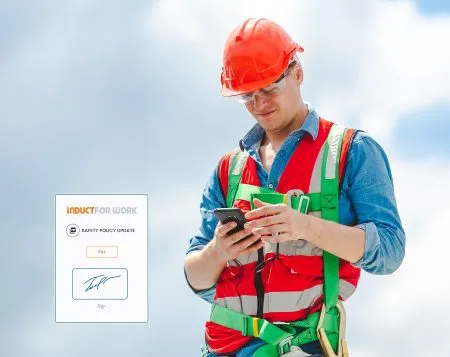
Digital e-signatures can make acknowledgements cleaner by linking the sign-off to the person, document and date. That does not replace the need for clear communication, but it does give the business a stronger record when confirmation is needed later.
Poor compliance can be expensive
Ignoring OHS compliance can cost a business in many ways.
The most serious cost is harm to people. An injury, illness or serious incident can affect a worker, family, team and business for a long time. Even less severe incidents can damage morale, confidence and trust.
Commercial costs can also be significant. A business may face downtime, investigation time, workers compensation costs, legal expenses, lost productivity, higher insurance pressure, contract problems, staff turnover, reputational damage and management distraction.
For some businesses, one serious incident can affect future tenders, client confidence and the ability to operate.
OHS compliance should therefore be seen as a business protection measure. It helps protect people first, while also protecting continuity, reputation and long-term viability.
Common OHS compliance gaps
Many compliance problems begin with small gaps that become normal.
A policy may be updated, but workers are not told. Contractors may arrive before documents are checked. Hazards might be reported verbally, but no action is recorded. An inspection can be completed without any follow-up on corrective actions. New processes sometimes begin before anyone reviews the risks.
These gaps are common because workplaces are busy. People rely on memory, email chains, paper folders or one person who knows where everything is.
That approach becomes risky as the business grows or changes.
Common gaps include:
- outdated procedures
- missing incident reports
- incomplete contractor records
- unclear responsibilities
- expired licences
- lapsed insurance documents
- weak consultation notes
- poor corrective action follow-up
- inconsistent visitor processes
- unreviewed workplace changes
- scattered policy acknowledgements
- limited visibility across sites
The fix is usually not complicated. Businesses need clearer ownership, better systems and regular review habits.
Incident and hazard reporting need clear pathways
A workplace can only fix problems it knows about.
That is why hazard and incident reporting should be simple, visible and taken seriously. Workers should know how to report a hazard, near miss, injury, unsafe condition or concern. Supervisors should know how to respond. Managers should be able to see whether corrective actions are being closed.
Informal reporting is not enough for a reliable OHS system. A verbal comment may be useful in the moment, but it can be forgotten if no one records the issue or assigns follow-up.
A structured incident reporting process helps businesses capture important details, review causes and keep a clearer record of what happened. It also supports learning because managers can see whether similar issues are repeating across teams, sites or tasks.
Building OHS compliance into everyday work
Strong compliance is built through routine.
A business should not wait for an incident or audit before checking whether its systems work. Instead, safety responsibilities should sit inside normal operating rhythms.
This may include regular workplace inspections, scheduled policy reviews, contractor document checks, hazard follow-up, incident review meetings, emergency drill planning, equipment maintenance checks and leadership discussions about safety performance.
Simple routines make compliance easier because they reduce reliance on memory.
Monthly checks can catch a missing document before it becomes a problem. Weekly supervisor discussions can identify hazards before someone is hurt. Scheduled reviews after workplace changes can prevent old procedures from being applied to new work.
The best systems are not necessarily the most complicated. They are the systems that people actually use.
Leadership sets the standard
OHS compliance depends heavily on leadership.
Workers notice whether managers take safety seriously. Contractors notice whether site rules are applied consistently. Supervisors notice whether executives support corrective actions or delay them. Visitors notice whether the business has an organised process or an improvised one.
Leadership does not require dramatic speeches. It is shown through everyday decisions.
A manager who stops unsafe work sends a clear message. Directors who ask about safety performance during business reviews show that safety is part of governance. Supervisors who follow up hazard reports build trust. Operations managers who include safety in planning help prevent problems before they reach the floor.
A compliant culture is built when leaders make safe work the normal way of working.
Contractors and visitors also matter
OHS compliance does not stop with direct employees.
Contractors, subcontractors, suppliers, delivery drivers, visitors, volunteers and customers may all be affected by the way work is managed. In many businesses, these groups move through the workplace every day.
Contractors may bring their own equipment, methods and risks. Visitors may not understand site hazards. Delivery drivers may enter loading areas. Volunteers may need clear boundaries. Customers may be affected by poor housekeeping, unsafe access or emergency arrangements.
A business should have a practical way to manage these groups.
That may include sign-in procedures, site rules, document checks, supervision requirements, emergency information, restricted areas, incident reporting pathways and clear responsibilities for the person hosting or managing them.
For businesses that rely heavily on subcontractors or service providers, a clear contractor management process can help define responsibilities before work begins.
Contractor documents should be checked before work starts
Contractor safety is not only about what happens after someone arrives onsite.
Before work begins, a business may need to check licences, insurances, permits, certificates, SWMS, SDS, qualifications or other documents. The exact requirements depend on the work being performed and the risk involved.
Manual checking can quickly become messy. Files may sit in email inboxes, renewal dates may be missed and supervisors may not know whether a contractor is ready to start.
A contractor pre-qualification process can help businesses collect and review required documents before contractors begin work. This is especially useful where contractors move between sites, perform higher-risk tasks or need evidence checked before access is granted.

Visitor processes should support site safety
Visitors may only be onsite for a short time, but they can still be exposed to hazards or create risk for others.
A visitor may not know where to go during an evacuation. A delivery driver may enter a loading area at a busy time. A client may walk through a workshop without understanding restricted zones. A volunteer may need basic site instructions before helping with an activity.
A structured visitor management process helps businesses record who is onsite, provide entry instructions and improve visibility. In some workplaces, this may be as simple as digital sign-in and clear directions. In others, it may include safety prompts, host notifications, visitor badges or short acknowledgements before access.
Multi-site businesses need consistent visibility
OHS compliance becomes harder when a business operates across several sites.
One location may keep excellent records, while another relies on memory. A regional manager may assume inspections are being completed, but the evidence may be inconsistent. Contractors may be properly checked at one site, then handled informally at another.
Multi-site businesses need a consistent way to see what is happening.
That does not mean every workplace must have identical procedures. Different sites may have different risks. However, the business should still have a common standard for reporting, record keeping, responsibilities, reviews and follow-up.
A reliable reporting process helps leaders compare sites, find weak areas and support managers before problems become serious.
Small businesses need simple systems
Small businesses sometimes avoid OHS compliance because they assume it requires a large corporate safety department.
That is not true.
A small business may need a simpler system, but it still needs to manage real risks. The essentials are often straightforward: know the hazards, involve workers, control risks, keep records, review problems and make sure responsibilities are clear.
The system should match the size and nature of the business.
A small workshop does not need the same structure as a national construction company. Still, it should know how hazards are reported, who checks equipment, where incident records are kept, how contractors are managed and what happens after something goes wrong.
Simple does not mean casual. It means clear, practical and used consistently.
Technology can support OHS compliance
Technology does not make a workplace safe by itself.
A digital system will not replace leadership, supervision, consultation or good judgement. However, the right system can help a business keep information organised, reduce manual chasing and make records easier to find.
Induct For Work can support parts of the compliance process by helping businesses collect documents, capture policy acknowledgements, manage digital forms, record incident reports, support visitor sign-in and keep completion records in one place.
For businesses that still rely on paper folders and scattered spreadsheets, this can make daily administration much easier.
The point is not to turn compliance into software for its own sake. The point is to give managers better visibility and a more reliable record of what has been done.
How safer systems support safety culture
A strong safety culture is not built from slogans. It grows from consistent behaviour.
When hazards are reported and acted on, people learn that speaking up matters. Consultation before workplace changes shows workers that their experience is valued. Proper records help the business learn from its own history. Clear contractor and visitor expectations make the workplace more predictable.
Culture improves when the system supports the behaviour the business wants to see.
This is why OHS compliance should not be treated as a separate administrative burden. It is one of the ways a business reinforces standards, protects people and creates accountability.
Who this is for
This page is for business owners, directors, managers, supervisors, safety officers, HR teams and administrators who want a clearer understanding of OHS compliance.
It may be useful for:
- small businesses building their first safety system
- growing organisations with more workers
- multi-site companies needing better visibility
- contractors preparing for client checks
- workplaces with changing risks
- businesses relying on suppliers
- teams moving away from paper records
- managers reviewing incident processes
- leaders improving consultation habits
- administrators organising compliance files
- supervisors closing corrective actions
- owners wanting practical safety routines
The principles apply across industries, although each workplace must consider its own risks and legal requirements.

Start with a practical review
Improving OHS compliance does not always require a major project.
A useful first step is to review what already exists. Check whether policies are current, people know how to report hazards, incident records are complete, contractor documents are up to date and corrective actions are being closed.
Then look for the weakest link.
For some businesses, the issue is contractor management. For others, it may be hazard reporting, consultation, visitor sign-in, policy acknowledgement or document control.
Fixing one weak area properly is often more valuable than creating a large system that no one uses.
If your organisation needs to move existing procedures, site rules, policies and compliance documents into a clearer process quickly, rapid induction setup can help turn existing material into a more organised digital workflow.
Keep OHS compliance simple enough to follow
A compliance system should be practical.
If a process is too complicated, people avoid it. Records that are hard to find stop being checked. Unclear responsibilities allow tasks to fall between roles. Forms that are too long become a barrier rather than a support.
Good OHS compliance should be clear enough for people to follow during real work.
That means plain language, practical procedures, defined responsibilities, easy reporting pathways, accessible records and regular reviews. It also means supervisors need the authority and support to act when issues arise.
The safer system is usually the one people understand and use consistently.
A final word on staying OHS compliant
Staying OHS compliant is important because every business has a duty to protect people from harm. It is also important because safer workplaces are more stable, more trusted and easier to manage.
Compliance should not be treated as a once-a-year exercise. It belongs in daily decisions, regular reviews, worker consultation, contractor management, incident follow-up and leadership behaviour.
For businesses that want to improve entry processes, policy acknowledgements and compliance visibility, an online induction system can form part of a broader OHS record-keeping approach without replacing supervision, consultation or practical risk control.
Start your 14-day free trial and see how Induct For Work can help your business keep OHS-related records clearer, more organised and easier to manage.
Frequently asked questions
OHS compliance means meeting workplace health and safety duties through practical systems, risk controls, consultation, records and ongoing review. It is about protecting people from harm and being able to show how risks are managed.
OHS compliance helps protect workers, contractors, visitors and customers. It also reduces operational disruption, improves accountability, supports legal duties and helps the business respond more effectively when risks or incidents arise.
OHS and WHS are often used to describe similar workplace health and safety responsibilities. WHS is now the common term in many Australian jurisdictions, while OHS remains familiar in some places and industries.
Responsibility can sit with business operators, officers, managers, supervisors, workers and other duty holders depending on the situation. Each person has duties that relate to the level of control or influence they have over the work.
Useful records may include incident reports, hazard reports, risk assessments, inspection results, consultation notes, policy acknowledgements, contractor documents, maintenance checks, corrective actions and emergency procedure reviews.
Procedures should be reviewed when work changes, after incidents, when hazards are identified, when laws or guidance change and at planned intervals. Regular review helps keep procedures current and useful.
Yes. Small businesses also have workplace health and safety duties. The system may be simpler than a large organisation’s system, but it still needs to manage real risks and keep suitable records.
Consultation helps businesses understand hazards and practical risks from the people closest to the work. It also supports better decisions because workers can raise concerns and contribute to safer procedures.
Yes. INDUCT FOR WORK can help organise records, collect acknowledgements, track contractor documents, record incidents, manage visitor information and make reports easier to access. INDUCT FOR WORK supports compliance administration but does not replace leadership or judgement.
Start by reviewing current risks, records and responsibilities. Identify the weakest area, such as contractor documents, incident reporting or consultation, then fix that area with a clear process that people can follow.
Warning signs include missing records, unclear responsibilities, outdated procedures, unclosed corrective actions, inconsistent contractor checks, weak consultation and safety information stored across too many disconnected places.
Do you have any questions or great tips to share?
Induct for Work – the only online induction system you would need to run online inductions.
Start a free trial or book a demo to see how INDUCT FOR WORK can support your workplace processes.
Author: Anna Milova
Published: 05/04/2018
Updated: 15/06/2026