Workplace Health and Safety: A Practical Guide for Safer Workplaces
Safer work starts with clear responsibility.
Workplace health and safety is about protecting people from harm while work is being done.
It includes the physical workplace, the way tasks are organised, the equipment people use, the condition of the work area, the behaviour expected from workers and the systems used to prevent injuries and illness.
In Australia, the exact wording can differ between jurisdictions. Some states and territories use the term work health and safety, often shortened to WHS. Victoria commonly uses occupational health and safety, often shortened to OHS. The practical aim is the same: people should be able to work without being exposed to unnecessary risk.
WorkSafe Victoria says the Occupational Health and Safety Act 2004 is the main workplace health and safety law in Victoria and that it sets out key principles, duties and rights about OHS. It also says the Act seeks to protect the health, safety and welfare of employees and other people at work and to make sure the public is not put at risk by work activities.
Safe Work Australia explains that consultation with workers and other duty holders is a legal requirement under the model WHS Act and an important part of managing workplace health and safety.
This page gives a practical overview of workplace health and safety for employers, managers, supervisors and workers.
It is general information only and should not replace regulator guidance or professional advice for a specific workplace.
What is workplace health and safety?
Workplace health and safety means identifying what could harm people at work and taking practical steps to prevent that harm.
It can include:
- safe work procedures
- hazard identification
- risk control
- consultation with workers
- equipment maintenance
- emergency planning
- incident reporting
- supervision
- welfare facilities
- safe systems of work
- workplace inspections
- contractor management
- injury prevention
- health monitoring where required
- return-to-work support where relevant
- review after incidents or changes
Workplace health and safety is not only about avoiding major accidents.
It also includes everyday matters such as safe walkways, clear emergency exits, well-maintained equipment, manageable workloads, proper lighting, suitable facilities and clear communication.
Good safety practice should be visible in daily work.
A policy on its own does not make a workplace safe.
Why workplace health and safety matters
Workplace health and safety matters because poor controls can lead to injuries, illness, lost time, damaged equipment, legal problems, higher costs and loss of trust.
A strong safety approach helps workplaces:
- prevent injuries and illness
- protect workers, contractors and visitors
- reduce avoidable disruption
- improve confidence in management
- support better supervision
- reduce repeated incidents
- meet legal obligations
- keep work areas organised
- respond faster when something goes wrong
- learn from near misses
- build better work habits over time
Health and safety should not be treated as a separate activity that sits outside normal work.
It should be part of planning, purchasing, staffing, supervision, maintenance, project work, contractor engagement and everyday decision-making.
For broader practical safety behaviour, see safety at work.
Employer duties
Employers have a duty to provide and maintain a workplace that is safe and without risks to health so far as reasonably practicable.
In Victoria, WorkSafe’s summary of general OHS duties includes matters such as providing safe plant and systems of work, maintaining workplaces in a safe condition, providing suitable facilities and giving employees the information, instruction, training or supervision they need to work safely and without risks to health.
In practical terms, employers should consider:
- workplace layout
- plant and equipment safety
- maintenance schedules
- safe work procedures
- worker consultation
- contractor safety
- supervision levels
- emergency planning
- incident response
- hazardous substances
- manual handling risks
- electrical risks
- traffic movement
- fatigue
- psychological health
- workplace facilities
- communication of safety information
The duty is not only about reacting after harm occurs.
Employers should identify hazards early, control risks and review whether the controls are actually working.
Worker responsibilities
Workers also have responsibilities.
They should take reasonable care for their own health and safety and take reasonable care that their actions do not harm others.
This usually means workers should:
- follow safe work procedures
- use equipment properly
- wear required PPE
- report hazards
- report injuries and near misses
- avoid interfering with safety controls
- ask for help when unsure
- follow reasonable safety instructions
- use machinery only when authorised
- keep work areas tidy
- speak up when conditions change
Workers are often the first people to notice that something is wrong.
They may see damaged equipment, blocked exits, slippery floors, missing guards, unsafe traffic movement, broken tools or repeated pressure to rush.
A workplace works better when workers feel able to raise issues early.
Consultation with workers
Consultation is one of the most important parts of workplace health and safety.
Managers do not always see the risks that workers face during the task. Workers often know where shortcuts happen, where equipment fails, where instructions are unclear and where controls are awkward to use.
Safe Work Australia states that consultation with workers and health and safety representatives is required when workers are likely to be affected by a WHS matter. It also says information should be presented in a way workers can understand.
Consultation may happen when:
- hazards are identified
- risks are assessed
- control measures are chosen
- work areas are changed
- new equipment is introduced
- procedures are updated
- incidents are reviewed
- worker facilities are discussed
- emergency arrangements change
- contractors and other duty holders share a workplace
Good consultation is more than telling people what has already been decided.
It means listening, considering practical feedback and explaining the final decision.
Identifying workplace hazards
A hazard is anything that can cause harm.
Common workplace hazards include:
- slips and trips
- falls from height
- moving vehicles
- forklifts
- machinery
- electricity
- chemicals
- dust
- noise
- manual handling
- sharp tools
- hot surfaces
- confined spaces
- poor lighting
- fatigue
- aggressive behaviour
- unsafe storage
- fire risks
- biological hazards
- poor housekeeping
- weather exposure
For a dedicated guide, see workplace hazards.
Hazards can be identified through inspections, worker reports, incident reviews, maintenance records, client feedback, safety meetings, audits and task observations.
A workplace should not wait for injury before fixing obvious hazards.
Near misses and small failures often give early warning.
Understanding risk
A hazard is the source of potential harm.
Risk is the chance that harm will happen and how serious the harm could be.
For example, a wet floor is a hazard. The risk depends on where the floor is, how slippery it is, who walks through the area, how quickly it can be cleaned and whether warning signs or barriers are used.
Risk can change when:
- work gets busier
- weather changes
- new people start
- equipment is damaged
- a task is rushed
- a contractor enters the area
- lighting becomes poor
- supervision is limited
- a procedure changes
- workers become tired
Good safety management looks at the real working conditions, not only the written procedure.
A risk assessment should lead to practical action.
Controlling risks
Once a risk is identified, the workplace needs to control it.
Controls may include:
- removing the hazard
- replacing a dangerous material or process
- isolating people from the hazard
- using guards, barriers or extraction systems
- changing the task
- improving equipment
- setting up safe traffic routes
- adding warning signs
- changing rosters
- using safer storage
- providing PPE
- improving supervision
- maintaining equipment
- reviewing procedures after incidents
Controls should be practical and reliable.
A sign may help, but it may not be enough for a serious hazard. A warning may be useful, but it does not remove the risk. PPE may be needed, but it should not be the only control when a higher-level control is available.
The best control is one that reduces the risk at the source.
Safe systems of work
A safe system of work explains how a task should be done safely.
It may include:
- task steps
- equipment requirements
- worker authorisation
- PPE
- isolation steps
- traffic control
- maintenance process
- emergency action
- supervision
- communication
- inspection points
- stop-work triggers
A safe system should match the actual work.
A procedure copied from another workplace may look complete but still fail if it does not reflect the site, equipment, layout or people involved.
Supervisors should check that safe systems are followed during the job, not only written down.
Workplace facilities
Workplace health and safety also includes basic facilities.
Depending on the workplace, this may include:
- toilets
- drinking water
- handwashing facilities
- dining areas
- change rooms
- first aid facilities
- lighting
- ventilation
- safe access
- rest areas
- storage
- waste management
- temperature control where reasonable
Facilities matter because they affect hygiene, comfort, fatigue and safe work.
Poor facilities can also create avoidable risks.
For example, a lack of suitable storage may lead to blocked exits or cluttered walkways.
Emergency planning
Every workplace needs emergency arrangements that workers can understand.
Emergency planning may cover:
- fire
- medical events
- evacuation
- severe weather
- chemical spills
- security events
- vehicle incidents
- power failure
- gas leaks
- first aid
- communication
- emergency contacts
- assembly areas
- warden roles
- after-hours response
Emergency procedures should not be hidden in a folder.
People should know what to do before an emergency happens.
Emergency plans should also be reviewed when work areas, staff numbers, site layout, equipment or operating hours change.
Incident and near miss reporting
Incidents and near misses should be reported, reviewed and used to improve controls.
A near miss is especially important because it shows that something nearly went wrong.
Reports may involve:
- injuries
- illness
- near misses
- hazards
- damaged equipment
- unsafe work areas
- vehicle incidents
- chemical spills
- electrical faults
- aggressive behaviour
- blocked exits
- fire risks
- PPE failures
- plant or machinery faults
For practical report examples, see incident report examples.
A reporting process should be simple enough that workers use it.
If reporting feels difficult, slow or pointless, hazards may stay hidden until someone is hurt.
Workplace inspections
Regular inspections help workplaces find hazards before they cause harm.
An inspection may look at:
- walkways
- exits
- plant and equipment
- machinery guards
- electrical leads
- storage
- housekeeping
- first aid supplies
- fire equipment
- PPE
- chemical storage
- signs
- lighting
- ventilation
- ladders
- vehicles
- outdoor areas
- contractor work zones
Inspections should lead to action.
A checklist is useful only if issues are fixed, responsibilities are assigned and follow-up occurs.
Small defects should not be ignored because they can become serious when work is busy or conditions change.

Contractors and visitors
Workplace health and safety does not stop with employees.
Contractors, suppliers, delivery drivers, labour hire workers, volunteers and visitors may also be affected by work activities.
Businesses should consider:
- site access
- emergency procedures
- restricted areas
- PPE
- traffic routes
- contractor documents
- supervision
- communication
- incident reporting
- sign-in and sign-out
- shared duties with other businesses
For contractor-specific readiness, see contractor induction.
When multiple businesses work in the same place, they may need to consult, cooperate and coordinate activities. Safe Work Australia says PCBUs must consult, cooperate and coordinate with other duty holders when they share a WHS matter.
This is especially important on construction sites, shared buildings, loading docks, client sites and events.
Mental health and psychological safety
Workplace health and safety includes more than physical hazards.
Work can affect psychological health when risks are poorly managed.
Issues may include:
- high job demands
- poor support
- bullying
- aggression
- fatigue
- unclear roles
- poor change management
- remote or isolated work
- traumatic events
- conflict
- lack of control over work
- poor communication
WorkSafe Victoria says health under the OHS Act includes both physical and psychological health.
For a dedicated guide, see mental health at work.
Psychological risks should not be dismissed as personal weakness.
If the way work is designed or managed creates risk, the workplace should review it and take reasonable steps to reduce harm.
Industry differences
Workplace health and safety looks different in every industry.
- Farm operations may focus on machinery, animals, chemicals, vehicles and heat.
- Hospitality venues often deal with burns, cuts, manual handling, aggression, food safety and wet floors.
- Construction businesses commonly manage falls, plant, electrical work, traffic, dust and contractors.
- Office environments may focus on ergonomics, emergency procedures, stress, security and working from home. An office may focus on ergonomics, emergency procedures, stress, security and working from home.
The best safety approach is specific to the work being done.
Generic documents rarely cover everything that matters.
Records and evidence
Workplace health and safety often requires good records.
Records may include:
- risk assessments
- inspection reports
- maintenance logs
- incident reports
- consultation notes
- corrective actions
- chemical registers
- equipment checks
- first aid records
- contractor documents
- emergency drill records
- licences and certificates
- worker acknowledgements
- training records where relevant
For broader record guidance, see record keeping.
Records should help people act.
They should not exist only to fill folders. A good record makes it easier to see what happened, what was done and what still needs follow-up.
Reviewing and improving safety
Workplace health and safety should improve over time.
Reviews may be needed when:
- an incident occurs
- a near miss is reported
- work changes
- new equipment is introduced
- staff numbers change
- contractors start work
- laws or regulator guidance change
- repeated issues appear
- inspections find problems
- workers raise concerns
- emergency arrangements change
Safety should not depend on a yearly review alone.
Small improvements made regularly can prevent larger problems later.
Common workplace health and safety mistakes
Treating safety as paperwork
Documents matter, but real safety depends on what happens during work.
Waiting for an injury
Near misses and hazard reports should trigger action before harm occurs.
Ignoring worker feedback
Workers often understand practical risks better than anyone else.
Using generic procedures
Safety instructions should match the actual workplace, task and equipment.
Forgetting contractors
External workers can create or face risks when site rules are unclear.
Failing to maintain equipment
A safe procedure will not help if equipment is damaged or guards are missing.
Letting small hazards become normal
Wet floors, blocked exits, poor lighting and damaged tools should not become accepted.
Not reviewing after change
Changes to work, staff, equipment or layout can create new risks.
Practical tips for better workplace health and safety
Walk through the workplace regularly
Look for hazards as work is actually being done.
Listen to workers
Ask what makes the job difficult, unsafe or unclear.
Fix obvious hazards early
Do not wait for a formal audit to remove a known risk.
Keep procedures practical
Workers should be able to understand and follow them.
Check controls still work
A control that worked last year may not work after changes.
Make reporting simple
People should know how to report hazards, near misses and incidents.
Review contractor arrangements
External workers need clear site rules and communication.
Keep improving
Use incidents, inspections and worker feedback to make better decisions.
Building a safer workplace
Workplace health and safety is not a one-off project.
It is an ongoing way of managing work so people are not exposed to unnecessary harm.
A safer workplace identifies hazards early, controls risks properly, consults workers, keeps equipment maintained, prepares for emergencies and responds when something goes wrong.
It also learns from experience.
When workers speak up, near misses are reviewed and controls are improved, safety becomes part of how the business operates.
For practical hazard guidance, see workplace hazards. For everyday safe work behaviour, see safety at work. For broader WHS program structure, see workplace health and safety program.
Frequently asked questions
Workplace health and safety is the process of identifying hazards, controlling risks and protecting people from harm while work is being done.
WHS means work health and safety. OHS means occupational health and safety. The terms are often used in similar ways, but wording differs between jurisdictions.
Employers have key duties to provide and maintain safe workplaces so far as reasonably practicable. Workers also have duties to take reasonable care and follow reasonable safety instructions.
Common hazards include slips, trips, falls, moving vehicles, machinery, electricity, chemicals, dust, noise, manual handling, fatigue, aggression and poor housekeeping.
Consultation helps employers understand practical risks and gives workers a way to raise safety concerns before harm occurs.
A near miss should be reported, reviewed and used to improve controls. It can show that a risk is not being managed well enough.
Yes. Health and safety includes physical and psychological health. Work-related stress, aggression, bullying, fatigue and poor support may all need attention.
Do you have any questions or great tips to share?
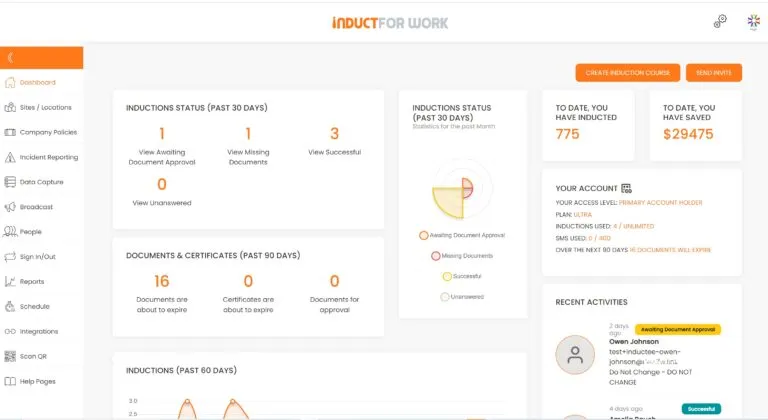
Induct for Work – the only online induction system you would need to run online inductions.
Start a free trial or book a demo to see how INDUCT FOR WORK can support your workplace processes.
Author: Anna Milova
Published: 04/02/2019
Updated: 02/06/2026