5x5 Risk Matrix: How to Score Workplace Risks and Set Clear Priorities
A 5×5 risk matrix helps workplaces assess risk by comparing two simple factors: likelihood and consequence.
Likelihood asks how likely a hazard or event is to happen. Consequence asks how serious the outcome could be if it does happen.
When you place those two ratings into a 5×5 grid, the matrix gives you a risk level. That level helps managers, supervisors, workers and contractors decide what needs urgent action and what needs routine control.
The current Induct For Work article explains that a 5×5 risk matrix compares likelihood and consequence in a 25-cell grid to prioritise risks. It also notes that risk assessment should form part of a wider process that identifies hazards, assesses risks, controls risks and reviews controls.
INDUCT FOR WORK helps businesses turn risk assessment training into online induction, online forms, acknowledgements, reporting and records. This helps workers and contractors understand how risk decisions work before they start.
A clear risk process also supports a stronger safety culture because people know how to recognise hazards, rate risks and report concerns. In addition, rapid induction setup can help businesses turn existing risk procedures, matrices, checklists and training material into online induction content sooner.
What is a 5x5 risk matrix?
A 5×5 risk matrix is a simple risk assessment tool.
It uses five levels of likelihood and five levels of consequence.
The two ratings create a 25-cell grid that helps people rank risk.
A simple version may look like this:
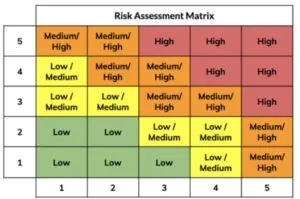
The risk score usually comes from multiplying likelihood by consequence.
For example:
Likelihood 4 x Consequence 5 = Risk Score 20
That score usually falls into a high or extreme risk category.
Why a 5x5 risk matrix matters
A 5×5 risk matrix matters because workplaces need a consistent way to compare risk.
Without a shared method, people may judge the same hazard differently.
One supervisor may see a forklift near miss as high risk. Another may see it as routine. A contractor may rate a task too low because they perform it often. A new worker may not understand the consequence at all.
A matrix gives teams a common language.
It helps businesses:
- compare risks more consistently
- decide what needs attention first
- explain risk decisions clearly
- support task planning
- prepare workers and contractors
- improve hazard reporting
- guide control selection
- support supervisor approval
- keep clearer records
- review risks after changes or incidents
As a result, risk assessment becomes easier to explain and easier to repeat.
Where a 5x5 risk matrix works best
A 5×5 risk matrix works well when teams need a practical risk-rating method.
It can support:
- workplace inspections
- task risk assessments
- contractor work planning
- SWMS review
- site inductions
- incident reviews
- machinery safety reviews
- chemical handling reviews
- manual handling assessments
- construction planning
- maintenance work
- event planning
- warehouse traffic management
- working at height reviews
- confined space planning
- emergency planning
The matrix works best when workers understand the rating terms and use the same definitions.
Therefore, the business should explain the matrix during training instead of assuming everyone will interpret it the same way.
Why risk scoring often becomes inconsistent
Risk scoring becomes inconsistent when people rely only on personal judgement.
A worker may rate likelihood based on how often they have seen something happen. A supervisor may focus on consequence. A contractor may understate the risk because they want the job to proceed.
INDUCT FOR WORK helps businesses explain risk scoring through online training, quizzes, forms and acknowledgements.
It can help when:
- workers do not understand likelihood ratings
- supervisors use different risk definitions
- contractors submit inconsistent risk assessments
- high-risk tasks need clearer approval rules
- risk matrices sit in PDFs but workers rarely use them
- hazard reports lack enough detail
- records sit across emails and folders
- managers cannot confirm who completed risk training
- refresher training gets missed after procedures change
With online training and records, businesses can explain how the 5×5 matrix works and keep evidence that workers received the information.
5x5 risk matrix vs qualitative risk analysis
A 5×5 risk matrix and qualitative risk analysis are closely related.
Qualitative risk analysis uses descriptive categories such as low, medium, high, likely, unlikely, minor, major or severe. The 5×5 matrix gives those categories a structured visual format.
| 5×5 Risk Matrix | Qualitative Risk Analysis |
|---|---|
| Specific 25-cell scoring tool | Broader risk assessment method |
| Uses five likelihood levels | May use simple or detailed categories |
| Uses five consequence levels | May use descriptive judgement |
| Produces a risk score or rating | Helps compare and prioritise risks |
| Useful for workplace forms and training | Useful for broader risk conversations |
For a wider explanation, see our qualitative risk analysis guide.
That article supports this page because it explains the broader method behind likelihood, consequence and priority.
The five likelihood levels
Likelihood means the chance that the event or harm could happen.
A workplace should define likelihood clearly so people do not guess.
1. Rare
The event may happen only in exceptional circumstances.
Example: a hazard exists, but controls make the event highly unlikely.
2. Unlikely
The event could happen, but people do not expect it under normal conditions.
Example: a trained worker follows a well-controlled task, but unusual failure remains possible.
3. Possible
The event might happen at some time.
Example: workers perform the task regularly and exposure exists.
4. Likely
The event will probably happen.
Example: workers often encounter the hazard and controls do not fully prevent exposure.
5. Almost certain
The event will happen often or soon.
Example: workers face the hazard repeatedly and existing controls do not work well.
The key is consistency. Teams should apply the same definitions across tasks, sites and departments.
The five consequence levels
Consequence means the seriousness of the outcome if the event happens.
A workplace should rate the most serious reasonably foreseeable outcome, not only the most common outcome.
1. Insignificant
The outcome may involve no injury, no meaningful damage or a very small disruption.
2. Minor
The outcome may involve first aid, minor damage or short disruption.
3. Moderate
The outcome may involve medical treatment, lost time, moderate damage or operational disruption.
4. Major
The outcome may involve serious injury, major damage, major disruption or significant business impact.
5. Severe
The outcome may involve fatality, permanent injury, catastrophic damage or major legal and operational consequences.
This matters because people often underrate consequence when a task has become routine.
For example, workers may treat a forklift near miss as “normal”, but the consequence of a collision could still be severe.
How to calculate a risk score
Most 5×5 matrices calculate risk by multiplying likelihood by consequence.
Risk score = likelihood x consequence
Examples:
| Likelihood | Consequence | Score | Typical Rating |
|---|---|---|---|
| 1 | 1 | 1 | Low |
| 2 | 3 | 6 | Medium |
| 3 | 4 | 12 | High |
| 4 | 5 | 20 | Extreme |
| 5 | 5 | 25 | Extreme |
A business may set its own rating bands.
For example:
| Score | Rating | Action |
|---|---|---|
| 1–4 | Low | Monitor and maintain controls |
| 5–9 | Medium | Plan controls and review |
| 10–16 | High | Act promptly and seek approval where needed |
| 17–25 | Extreme | Stop work or control risk before proceeding |
The exact bands may vary. However, the business should explain the bands clearly and apply them consistently.
Step-by-step: how to use a 5x5 risk matrix
Step 1: Identify the hazard
Start with a clear hazard description.
For example:
- moving forklifts near pedestrians
- exposed electrical cable
- missing machine guard
- chemical splash risk
- working at height near an open edge
- manual handling of heavy boxes
- confined space entry
For a broader hazard overview, see our 7 common workplace safety hazards article.
Step 2: Describe the possible harm
Explain what could happen.
For example:
- worker struck by forklift
- electric shock
- hand injury from moving machinery
- chemical burn
- fall from height
- back strain
- low oxygen exposure
Step 3: Rate likelihood
Choose a likelihood rating from 1 to 5.
Base the rating on task frequency, exposure, existing controls, incident history and work conditions.
Step 4: Rate consequence
Choose a consequence rating from 1 to 5.
Consider the most serious reasonably foreseeable outcome.
Step 5: Calculate the score
Multiply likelihood by consequence.
For example:
Possible 3 x Major 4 = 12
Step 6: Choose controls
Use the rating to decide how urgently the business needs action.
Higher risks need stronger and faster controls.
Step 7: Record and review
Record the assessment, controls, responsible person and review date.
Review the risk after incidents, near misses, equipment changes, procedure changes or site changes.
Example 5x5 risk matrix
Here is a simple 5×5 matrix example.
| Consequence ↓ / Likelihood → | 1 Rare | 2 Unlikely | 3 Possible | 4 Likely | 5 Almost Certain |
|---|---|---|---|---|---|
| 5 Severe | 5 | 10 | 15 | 20 | 25 |
| 4 Major | 4 | 8 | 12 | 16 | 20 |
| 3 Moderate | 3 | 6 | 9 | 12 | 15 |
| 2 Minor | 2 | 4 | 6 | 8 | 10 |
| 1 Insignificant | 1 | 2 | 3 | 4 | 5 |
A business can colour-code this matrix in its own documents. However, workers should not rely only on colour. The scoring rules and action expectations need clear wording.
Choosing controls after scoring the risk
A risk matrix should lead to action.
The score does not fix the hazard by itself.
After scoring the risk, teams should decide which controls will reduce the risk.
Controls may include:
- removing the hazard
- replacing the task or material
- separating people from the hazard
- installing engineering controls
- changing procedures
- training workers
- supervising the task
- using PPE
Where possible, businesses should choose stronger controls before relying only on PPE or instructions.
For example, a forklift risk may need physical separation, marked walkways and traffic rules. A sign alone will rarely provide enough protection.
Using a 5x5 risk matrix in online induction
A 5×5 risk matrix works well in induction training because it helps workers understand how the business thinks about risk.
A risk matrix module may explain:
- what likelihood means
- what consequence means
- how to calculate a risk score
- what each rating level means
- when workers must stop work
- when supervisors need approval
- how to report hazards
- how to review controls
- where forms are stored
With online safety induction, businesses can introduce risk-rating methods before people begin work.
Quizzes can also help check understanding.
For example, a quiz may ask a worker to rate a hazard, choose the more serious consequence or decide whether a task needs supervisor approval.

Using custom forms for risk assessments
A 5×5 matrix becomes more useful when workers can record assessments clearly.
With custom forms, businesses can create online risk assessment forms that include:
- hazard description
- likelihood rating
- consequence rating
- risk score
- control measures
- responsible person
- review date
- worker acknowledgement
- supervisor approval
- photo upload
- follow-up action
This helps businesses move risk assessment away from paper forms and scattered spreadsheets.
With digital signatures, workers and supervisors can acknowledge important forms and declarations online.
Reporting hazards and near misses after risk assessment
Risk assessment should connect with reporting.
If workers identify a new hazard, failed control or near miss, they need a simple way to report it.
INDUCT FOR WORK supports incident reporting so businesses can capture hazards, near misses and incidents online.
This matters because real workplace information often changes the risk rating.
For example:
- repeated forklift near misses may increase likelihood
- a machine guard failure may increase consequence
- a chemical spill may show that controls need review
- a manual handling injury may reveal poor task design
When reports feed back into risk review, the matrix becomes more useful.
Record keeping for 5x5 risk matrix training
Risk training and risk assessments need clear records.
Managers may need to check:
- who completed risk matrix training
- when training occurred
- which workers passed a quiz
- which contractors acknowledged risk procedures
- which forms workers submitted
- which hazards workers reported
- which controls managers reviewed
- which assessments need updating
- which certificates the system issued
INDUCT FOR WORK helps improve record keeping by keeping training records, forms, certificates and acknowledgements online.
In addition, reporting helps managers review completion status and follow up where needed.
This gives businesses better visibility than paper files, spreadsheets or email trails.
Common mistakes when using a 5x5 risk matrix
Treating the matrix as the whole risk assessment
The matrix supports risk assessment. It does not replace hazard identification, controls or review.
Using vague definitions
If people do not understand the ratings, they will score risks differently.
Rating consequence too low
Teams sometimes rate the most common outcome instead of the most serious reasonably foreseeable outcome.
Ignoring existing controls
Likelihood should consider current controls, but only if those controls actually work.
Failing to review after change
Risk ratings may change when equipment, people, procedures or conditions change.
Using scores without action
A risk rating should guide what happens next. If it does not change the decision, the process needs review.
Why use INDUCT FOR WORK for risk matrix training and records?
A 5×5 risk matrix only works when people understand it and use it consistently.
INDUCT FOR WORK helps businesses:
- deliver risk matrix training online
- assign content by role or site
- explain likelihood and consequence
- use quizzes to check understanding
- collect acknowledgements
- create risk assessment forms
- support hazard and incident reporting
- track completion
- issue certificates
- assign refresher training
- keep records in one platform
This does not replace competent risk assessment or supervisor judgement. Instead, it supports the training, forms and records that help risk assessment work properly.
From paper risk matrices to clearer online records
| Paper-Based Risk Matrix Process | INDUCT FOR WORK |
|---|---|
| Teams store matrix templates in folders | Teams can access training online |
| Workers interpret ratings differently | Training can explain the rating method |
| Contractors submit different formats | Administrators can assign standard forms |
| Acknowledgements sit on paper | The system can capture digital acknowledgements |
| Risk forms go missing | Teams can keep forms online |
| Hazards stay in verbal conversations | Workers can submit reports online |
| Managers chase training manually | Reports show who needs follow-up |
| Refresher training gets missed | Administrators can assign updated training |
| Old matrix versions stay in use | Teams can update online content |
| Records take time to find | Managers can search records more easily |
This gives businesses a clearer way to manage risk training, assessment forms and supporting records.
Best practice tips for using a 5x5 risk matrix
Define each rating clearly
Workers should understand what rare, possible, likely, minor, major and severe mean.
Use real workplace examples
Examples from actual tasks help people score risk more consistently.
Train supervisors first
Supervisors often review risks and approve work, so they need a shared understanding.
Avoid false precision
A 5×5 matrix guides judgement. It does not produce a perfect scientific number.
Link scores to action
Each rating band should tell people what to do next.
Review after incidents
Incidents and near misses can show that the risk score or controls need review.
Keep forms and records together
Training, risk forms, reports and acknowledgements should sit where managers can find them.
Start improving risk assessment training and records
A 5×5 risk matrix gives workplaces a practical way to compare hazards, score risks and decide what needs attention first.
However, the matrix only works well when people understand the rating method and apply it consistently.
INDUCT FOR WORK helps businesses deliver risk matrix training online, create supporting forms, collect acknowledgements, support incident reporting and keep records in one platform.
Whether your workplace manages contractors, machinery, chemicals, construction work, events, warehouses, field work or office-based risks, INDUCT FOR WORK can help you communicate risk processes more clearly.
Give workers and contractors a better way to understand risk before work begins.
7) Frequently asked questions
A 5×5 risk matrix is a risk assessment tool that compares five levels of likelihood with five levels of consequence to produce a risk score or rating.
Most workplaces calculate the score by multiplying likelihood by consequence. For example, likelihood 4 x consequence 5 gives a risk score of 20.
A 5×5 risk matrix is a specific scoring tool. Qualitative risk analysis describes the broader method of assessing risk using descriptive categories.
The workplace should choose controls, assign responsibility, record the decision and review the risk after changes, incidents or near misses.
Yes. A 5×5 risk matrix can form part of online induction or safety training so workers understand how the business rates risk.
Yes. INDUCT FOR WORK helps businesses deliver risk matrix training, collect acknowledgements, create forms, support incident reporting and keep records online.
Managers should review risk ratings when tasks, equipment, workers, site conditions or procedures change. They should also review ratings after incidents, near misses or failed controls.
Author: Matt Tsashkuniats
Published: 27/03/2024
Last updated: 11/05/2026