
Managing contractors is rarely straightforward. Different companies, changing crews, tight deadlines, varying site rules and compliance obligations can make contractor onboarding harder to control than a standard employee induction. Many businesses also need to manage short-term work, multiple locations, high-risk activities and document checks all at once.
That is why an online induction system for contractors can make such a difference. Instead of relying on paper forms, rushed gate briefings, scattered email records and manual follow-up, businesses can move to a clearer digital process that is easier to manage, easier to scale and easier to audit.
A good online induction system for contractors helps businesses deliver the right induction content before site entry, collect licences and insurances, confirm understanding and maintain a reliable digital record of completion. It also helps reduce delays, improve compliance visibility and support safer contractor management across every site.
If your business wants a better way to manage contractor safety, compliance and site access, contractor induction software can play an important role.
Key takeaways
- Contractor inductions are often more complex than employee inductions because contractors may work across different sites, perform different tasks and need current licences or insurances.
- A strong online induction system should support role-based content, site-specific rules, document collection, assessments, mobile access and reporting.
- Online inductions help contractors complete requirements before arrival, reducing delays at entry points and improving site readiness.
- Digital records and audit trails make it easier to see who is compliant and what still needs action.
- A well-designed contractor induction process can improve safety, reduce administration and support stronger compliance across the business.
Contents
- What an online induction system for contractors is
- Why contractor inductions are different from employee inductions
- Why manual contractor induction processes often go wrong
- What good contractor induction software should include
- Why document collection and verification matter
- How online inductions improve contractor readiness and site access
- Why reporting and audit trails matter in contractor management
- How contractor induction software supports safer and more efficient worksites
- Frequently asked questions
- Keep contractor inductions clearer with INDUCT FOR WORK
1. What an online induction system for contractors is
An online induction system for contractors is a digital platform that helps businesses create contractor-specific inductions, deliver them online, collect supporting documents, test understanding and store induction records for compliance and audit purposes.
In practical terms, this means a business can:
- create contractor induction pathways for different roles and sites
- send induction invitations before work begins
- collect licences, tickets, white cards and insurance records
- use online quizzes or assessments to confirm understanding
- keep a digital record of induction activity
- check contractor readiness before site entry
This creates a more structured process than handing out forms at the gate or delivering a rushed site talk on a busy morning. Contractors can complete inductions before they arrive and your team can review whether they are ready to work before access is approved.
2. Why contractor inductions are different from employee inductions
Employee inductions are often more stable. New employees usually follow a standard onboarding process, work within a defined role and are managed directly by the business. Contractor inductions are different.
Contractors may:
- work across several sites
- perform very different tasks
- carry different levels of risk
- require different licences or insurances
- work for short periods, seasonal jobs, shutdowns or project-based assignments
This means contractor induction software needs to be more flexible than a standard onboarding tool.
Different roles need different content
Electricians, labour hire workers, delivery drivers, cleaners, specialist trades and project contractors do not all need the same induction. A strong system should let businesses assign content based on contractor role, work type and site requirements.
Different sites have different rules
Contractors may move between locations and each site may have its own hazards, entry procedures, traffic flow, emergency arrangements and restricted areas. The induction process should reflect that.
Compliance records can change
Licences, insurances and other documents can expire. That means contractor approval should not be treated as a one-off check. Businesses need a way to track records and identify when something is missing or out of date.
Contractor numbers can change quickly
During shutdowns, peak periods or project expansions, businesses may need to induct many contractors within a short timeframe. A digital induction process makes that easier to manage without losing control.

3. Why manual contractor induction processes often go wrong
Manual contractor induction processes often create delays, inconsistencies and avoidable compliance gaps. When businesses rely on paper forms, email chains, spreadsheets and verbal briefings, it becomes harder to keep everything organised.
Common problems include:
Delays at site entry
If a contractor arrives before paperwork is complete, site access can be delayed while someone checks documents, explains requirements or tries to confirm approval.
Inconsistent messages
One contractor may receive detailed instructions while another gets only a quick summary. That makes the induction process harder to control and less reliable.
Missing or outdated documents
When licences, tickets and insurance records are managed manually, it is easier for expired or missing records to slip through unnoticed.
Poor visibility
Managers may struggle to answer simple questions such as who has completed induction, who is approved for a site or which contractor still needs to provide documents.
Too much administration
Chasing paperwork, filing records, checking expiry dates and repeating the same information wastes time that could be spent on more useful safety and operational work.
An online induction system helps reduce these problems by giving businesses a clearer and more repeatable process.
4. What good contractor induction software should include
A contractor induction system should do more than deliver basic training. It should support the full contractor onboarding process in a practical way.
Role and site-based inductions
The system should allow businesses to create different induction templates for different contractor groups, trades and sites. This helps keep content relevant and avoids wasting time on information that does not apply.
Document collection and tracking
Businesses should be able to collect licences, tickets, insurances and other supporting records as part of the induction process. The system should also help track expiry dates and make it easier to identify missing items.
Assessments and proof of understanding
A good online induction should include quizzes or assessments so businesses can confirm that contractors understood key site rules, hazards and procedures.
Mobile-friendly access
Most contractors are on the move. The induction process should work well on mobile phones and tablets so contractors can complete it conveniently before arrival.
Reporting and audit trails
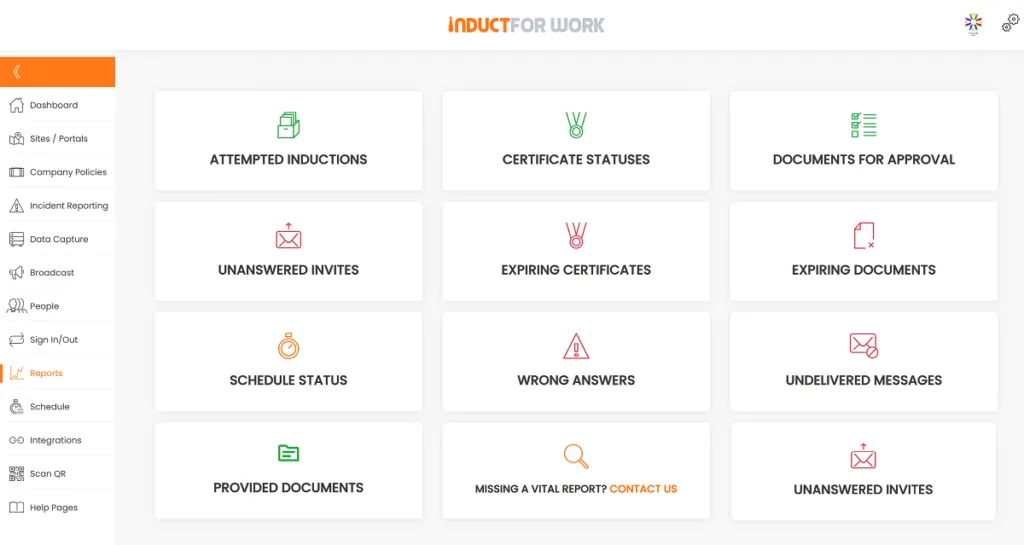
Managers should be able to see who has completed induction, who still has outstanding actions and what records were submitted. That visibility is important for compliance, internal reviews, audits and incident investigations.
Easy administration
A practical system should reduce admin rather than create more of it. It should be straightforward to update content, send invitations, check records and track completion status.
5. Why document collection and verification matter
Document control is one of the most important parts of contractor management. Businesses often need to check whether contractors hold the right licences, tickets, white cards, insurances or other supporting records before they begin work.
This matters because contractor approval should not depend on memory, paper folders or spreadsheet checks. A digital system makes it easier to:
- collect required records before site entry
- store documents in one place
- see which records are current
- track expiry dates
- identify non-compliant contractors quickly
Without a clear process for document collection and verification, businesses can lose visibility over who is actually ready to work. That creates risk and can undermine the value of the induction itself.
6. How online inductions improve contractor readiness and site access
One of the biggest advantages of online induction software is that it allows contractors to complete requirements before they arrive.
This improves contractor readiness in several ways.
Contractors understand the rules earlier
They can review site instructions, hazards, PPE requirements, emergency procedures and reporting expectations before they step onto the worksite.
Site access becomes easier to manage
If induction completion and document checks are done in advance, supervisors and gate staff can confirm readiness more quickly.
Delays are reduced
Businesses can avoid bottlenecks caused by last-minute paperwork, missing records or on-the-spot inductions.
Supervisors spend less time repeating information
Because the induction content is delivered consistently online, site teams do not have to start from scratch every time a new contractor arrives.
Contractors arrive closer to work-ready
This supports smoother operations and helps businesses maintain better control over who is allowed on site.
7. Why reporting and audit trails matter in contractor management
A contractor induction system should not simply deliver content. It should also provide a reliable audit trail.
Businesses often need to answer questions such as:
- Who is inducted for this site?
- Which contractors have incomplete inductions?
- Which documents are missing or expired?
- When did a contractor complete their induction?
- What content was assigned to that contractor?
Having clear answers to those questions matters for:
- compliance checks
- internal reviews
- audit preparation
- client requirements
- incident investigations
- insurer queries
When records are centralised, businesses can respond more quickly and with more confidence. That is one of the main reasons reporting and digital record keeping are so valuable in contractor management.
8. How contractor induction software supports safer and more efficient worksites
A better induction process does more than replace paper. It supports safer and more efficient worksites overall.
Contractor induction software can help businesses:
Improve safety consistency
Every contractor receives the same core information, reducing the chance that important instructions are missed.
Strengthen compliance visibility
Managers can see who has completed induction, who is missing records and which contractors may need follow-up before work begins.
Reduce administration
Automation, self-service completion and centralised records reduce the burden on supervisors and administrators.
Support multi-site operations
Businesses can keep core induction content consistent across all sites while still adding local site-specific rules where required.
Scale more easily
Whether a business is inducting a handful of specialist contractors or a large rotating workforce, a digital system makes the process easier to manage.
This is especially important for organisations that rely heavily on contractors across different locations, changing projects or high-risk work environments.
9. Frequently asked questions
INDUCT FOR WORK is a digital system that allows businesses to create contractor-specific inductions, deliver them online, collect documents, confirm understanding and store records for compliance and audit purposes.
Contractors may work across several sites, perform different tasks, hold documents with expiry dates and work on short-term or project-based arrangements. That makes their induction needs more variable.
It should include role and site-based inductions, document collection, expiry tracking, assessments, mobile access, reporting and reliable digital records.
Because businesses often need to collect and verify licences, tickets, white cards, insurances and other records before allowing contractors onto site.
Yes. Induct For Work induction system works well on phones and tablets so contractors can complete inductions before arrival.
It allows businesses to issue induction content and collect documents in advance, reducing last-minute paperwork and delays at site entry.
Yes. It can help businesses maintain consistent standards across multiple locations while still applying site-specific instructions where needed.
10. Keep contractor inductions clearer with INDUCT FOR WORK
If your business needs a better way to induct contractors, collect supporting documents, check compliance and maintain clear records, INDUCT FOR WORK can help.
Instead of relying on paper forms, rushed gate briefings and scattered administration, your team can move to a system that helps contractors complete inductions before arrival, supports document tracking, confirms understanding and gives managers better visibility over who is ready to work.
That means a more consistent induction process, better control over contractor compliance, less manual follow-up and stronger support for safe site access.
Do not leave contractor induction to guesswork and manual paperwork.
Start a free trial or book a demo to see how INDUCT FOR WORK can help your business improve contractor safety, strengthen compliance, reduce admin and keep site access under better control.
The current page covers contractor-specific inductions, document collection, assessments, mobile access, reporting and implementation advice, so the rewrite above keeps those same core themes while presenting them in the cleaner structure used on the employee onboarding software article.
Start a free trial or book a demo to see how INDUCT FOR WORK can support your workplace processes.