
How to plan a council-wide induction program without creating duplicated processes
City councils manage a wide range of people, services, facilities and public responsibilities.
A council induction program may need to support office staff, depot workers, outdoor teams, contractors, volunteers, visitors, temporary workers and elected councillors. Each group needs clear information, but not every group needs the same induction.
That is why councils need a guide before they build the content.
This city council induction guide explains how to plan a council-wide induction program, reduce duplication between departments, separate user groups, assign ownership, review content and keep records organised.
For practical checklist items and example template sections, visit our city council induction template page.
For a broader overview of council online induction software, visitor sign-ins, contractor records and reporting, visit our main city council online inductions page.
INDUCT FOR WORK helps councils move from planning to delivery by turning induction content into online training, forms, acknowledgements, certificates and completion records.
A well-planned induction program also supports a stronger safety culture by making council expectations clearer from the beginning. In addition, rapid induction setup can help councils move existing documents, PDFs and training material into an online process sooner.
What is a city council induction guide?l
A city council induction guide is a planning resource that helps councils design an induction program for the people who work for, represent, visit or support the organisation.
It is different from a template.
A template gives council teams a checklist or reusable structure. A guide helps councils decide how the overall induction program should work.
A city council induction guide can help answer questions such as:
- Which groups need induction?
- Which information should apply to everyone?
- Which content should apply only to certain roles or sites?
- Who owns the induction program?
- How often should the content be reviewed?
- How should councillor induction differ from staff induction?
- How should contractor and visitor pathways be managed?
- How will records be stored and checked?
- What reports should managers be able to access?
- How should refresher training be handled?
In other words, the guide helps councils design the system behind the induction process.
After that, templates and online tools can help deliver the actual training.
Why councils need an induction strategy
Many Australian and New Zealand councils already have policies, procedures, safety documents and staff handbooks.
However, having documents is not the same as having a well-managed induction strategy.
Without a clear strategy, each department may build its own process. One team may use a PDF. Another may use a spreadsheet. A third may send documents by email. Contractors may receive site rules verbally and volunteers may only receive a quick briefing.
Over time, this creates duplication and confusion.
A council-wide induction strategy helps define:
- who needs induction
- what each group needs to complete
- which content should be standard across council
- which content should be site-specific
- who approves induction material
- who tracks completion
- where records are stored
- when refresher training is required
- how managers know who is ready to work or attend
Therefore, a strategy gives councils a cleaner way to manage induction instead of leaving every department to solve the same problem separately.

Where council induction planning matters most
Council induction planning matters anywhere people need to understand council expectations before starting work, entering a site or representing the organisation.
It is especially important for:
- new council employees
- outdoor workers
- depot staff
- parks and gardens teams
- road maintenance crews
- waste facility workers
- library and customer service staff
- aquatic centre teams
- contractors and subcontractors
- consultants
- temporary workers
- labour hire staff
- volunteers
- committee members
- visitors entering operational areas
- elected councillors
Each group plays a different role.
As a result, a council-wide induction program should not force everyone through the same long course. Instead, it should provide core council information, then add the right site-specific or role-specific modules where needed.
Why council induction programs become fragmented
Council work is varied, public-facing and spread across many locations.
That makes induction planning more complex than it first appears.
A council may need to train a new office employee, brief an outdoor crew member, onboard a contractor for roadworks, prepare a volunteer for a community event and induct a councillor after an election. These are all induction needs, but they are not the same task.
INDUCT FOR WORK helps councils manage this complexity by giving teams one place to deliver training, collect forms and keep records.
Induction programs often become fragmented when:
- departments create their own separate processes
- contractor records sit in email inboxes
- volunteer briefings happen verbally
- councillor onboarding sits outside the broader training framework
- employees receive outdated policy documents
- visitor safety information is handled informally
- records are spread across folders and spreadsheets
- managers cannot see who completed training
- site-specific information is not clearly separated
- refresher training is not assigned after procedures change
- no single person or team owns induction content
- each location uses different forms or checklists
With a planned induction approach, councils can separate what everyone needs to know from what only applies to certain groups.
Step 1: Map every induction audience
The first step is to identify every group that needs induction.
Councils often start with employees, but the induction audience is usually much broader.
Groups may include:
- employees
- contractors
- subcontractors
- consultants
- volunteers
- visitors
- elected councillors
- committee members
- temporary workers
- labour hire workers
- service providers
- event workers
- delivery drivers
Once these groups are listed, council teams can decide which induction pathway each group needs.
For example, a contractor may need site access rules and document upload requirements. A volunteer may need conduct expectations and event instructions. A councillor may need governance, confidentiality and code of conduct training.
This mapping step helps councils avoid giving everyone the same induction simply because it is easier to administer.
Step 2: Separate core content from specialist content
A good council induction program usually has two layers.
The first layer is council-wide content. This includes information that most users should receive.
The second layer is specialist content. This includes information that only applies to certain roles, sites or activities.
Council-wide content may include:
- council overview
- expected conduct
- safety responsibilities
- emergency principles
- incident and hazard reporting
- privacy and information handling
- working with the public
- record keeping expectations
- how to ask for help
Specialist content may include:
- depot access rules
- plant and vehicle movement
- roadworks safety
- library procedures
- parks and gardens hazards
- aquatic centre requirements
- waste facility instructions
- contractor document requirements
- volunteer boundaries
- councillor governance responsibilities
This structure avoids making every user complete unnecessary training.
It also makes updates easier because council teams can revise one module without rebuilding the entire induction program.
Step 3: Create clear induction pathways
An induction pathway is the set of modules, forms and acknowledgements assigned to a specific user group.
For example, a council may have separate pathways for:
- new employees
- depot workers
- outdoor teams
- contractors
- volunteers
- visitors
- councillors
- event workers
- temporary staff
Each pathway should have a clear purpose.
A new employee pathway may focus on workplace policies, safety responsibilities, council systems and public service expectations.
A contractor pathway may focus on site access, safety rules, permits, SWMS requirements and reporting steps.
A councillor pathway may focus on governance responsibilities, meeting processes, confidentiality, conflicts of interest and community representation.
A visitor pathway may be short and focus only on site entry, emergency procedures and restricted areas.
For checklist-level detail, the city council induction template page can help councils build out each pathway.
Step 4: Assign ownership and review responsibility
A council induction program needs clear ownership.
Without ownership, content becomes outdated. Different departments may make their own versions and managers may not know which version is current.
Council teams should decide:
- who owns the induction framework
- who approves new induction content
- who updates policies and procedures
- who manages contractor requirements
- who reviews site-specific information
- who checks completion reports
- who follows up incomplete training
- who reviews induction feedback
- who manages councillor induction content
- who archives old versions
For many councils, ownership may sit with safety, HR, governance, risk, operations or a shared working group.
The important point is that someone must be responsible for keeping the program accurate.
Step 5: Build councillor induction into the framework
Elected councillors have a different role from employees, contractors and volunteers.
They may not need the same workplace induction as staff, but they still need a structured introduction to council responsibilities.
Councillor induction may include:
- council structure
- governance framework
- meeting procedures
- role boundaries
- code of conduct
- conflicts of interest
- confidentiality
- public communication expectations
- privacy and information handling
- record keeping responsibilities
- workplace behaviour expectations
- safety information for site visits
- how to access support and advice
Councillor induction should not sit in a completely disconnected process.
Instead, councils can include councillor onboarding as a separate pathway within the broader induction framework. This keeps the content appropriate while supporting better records and review.
Step 6: Plan contractor and external worker pathways
Contractors are often one of the highest-priority groups for council induction planning.
They may work in depots, roads, parks, public buildings, waste facilities, events, maintenance areas or active worksites.
A contractor induction pathway may cover site rules, emergency information, PPE, public safety, access requirements and reporting steps.
However, the guide page should not become a contractor checklist. The purpose here is to decide how contractor induction fits into the council-wide program.
Key planning questions include:
- Which contractors need induction before arrival?
- Which contractor groups need site-specific content?
- Which documents must contractors provide?
- Who reviews contractor documents?
- Which contractor records should be retained?
- How often should contractor induction expire?
- How will contractors receive updates when site rules change?
- How will high-risk contractor work be handled?
Once those decisions are made, councils can use the template page to develop practical content.
Step 7: Keep visitor and volunteer pathways short
Visitors and volunteers often need shorter pathways.
A visitor attending a restricted council area does not need a full staff induction. A volunteer helping at a community event does not need every internal procedure.
However, both groups may still need basic information.
This may include:
- sign-in rules
- host or supervisor details
- emergency procedures
- restricted areas
- expected conduct
- public interaction expectations
- privacy reminders
- incident and hazard reporting
- PPE where relevant
When connected with visitor management, councils can give short safety information and keep clearer records of who attended.
The planning goal is simple. Give people what they need without overloading them.
Step 8: Decide which forms and records matter
Inductions often include supporting forms and acknowledgements.
However, not every group needs the same forms.
Council teams should decide which records matter for each pathway.
Examples may include:
- policy acknowledgements
- safety declarations
- contractor forms
- volunteer forms
- emergency contact forms
- licence upload fields
- insurance document uploads
- SWMS submissions
- visitor acknowledgements
- confidentiality acknowledgements
- code of conduct acknowledgements
- privacy declarations
- incident reporting acknowledgements
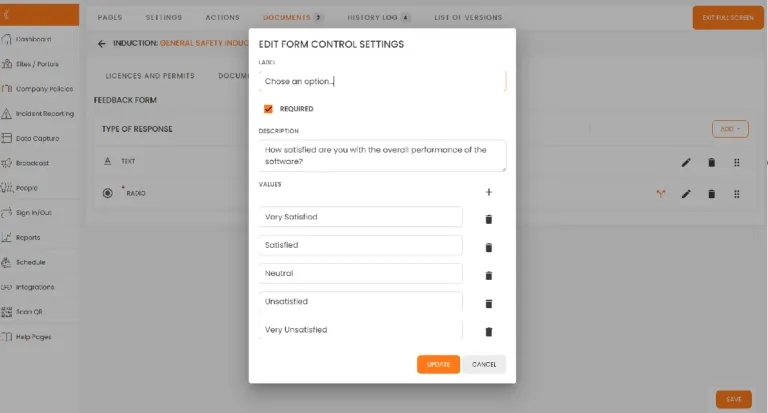
With custom forms and digital signatures, councils can collect forms and acknowledgements online.
As a result, teams can reduce paper handling and make records easier to retrieve later.
Step 9: Define reporting needs before rollout
Reporting should not be an afterthought.
Councils should decide early what managers and administrators need to see.
Useful reports may show:
- induction completion by department
- contractor completion by site
- overdue training
- incomplete forms
- expired contractor records
- councillor induction completion
- volunteer training status
- visitor acknowledgement records
- refresher training due dates
- records by location or group
INDUCT FOR WORK helps improve record keeping by storing induction records, forms, certificates and acknowledgements online.
In addition, reporting helps administrators check completion status and identify missing records.
This gives councils a clearer view across staff, contractors, volunteers, visitors and councillors.
Step 10: Review the program regularly
A council induction program should not remain unchanged for years.
Procedures change. Sites change. Council contacts change. Regulations change. New risks appear and old documents become outdated.
Councils should review induction content when:
- policies change
- emergency procedures change
- site layouts change
- a new contractor process starts
- incidents or near misses show a training gap
- new facilities open
- council structure changes
- elections bring new councillors
- forms or document requirements change
- workers give feedback
- managers identify repeated confusion
Regular review helps keep induction content useful and current.
It also supports better training habits across the organisation.

Step 11: Move from planning to online delivery
Once a council has planned its induction framework, the next step is delivery.
A paper document or PDF may work as a starting point, but it can be hard to manage across a council environment.
INDUCT FOR WORK can help councils turn induction plans into online training workflows.
This may include:
- online modules
- role-based pathways
- site-specific content
- quizzes
- document uploads
- custom forms
- acknowledgements
- certificates
- refresher training
- reporting
- stored records
For councils that are ready to manage the full process online, the city council online inductions page explains how INDUCT FOR WORK supports online training, contractor records, visitor sign-ins and reporting.
This guide should help with planning. The software page explains implementation.
From fragmented induction planning to council-wide visibility
| Fragmented Council Induction Planning | Council-Wide INDUCT FOR WORK Approach |
|---|---|
| Each department builds its own process | A shared framework can guide all departments |
| One long induction is used for everyone | Different groups can receive relevant pathways |
| Contractor records sit in emails | Contractor documents can be uploaded online |
| Volunteer briefings happen verbally | Short volunteer pathways can be assigned |
| Councillor induction sits outside training records | Councillor induction can become a dedicated pathway |
| Visitor safety information is informal | Visitor acknowledgements can be recorded |
| Forms are printed and filed | Forms can be completed online |
| Acknowledgements are hard to prove | Acknowledgements can be captured digitally |
| Completion is tracked manually | Completion status can be reported |
| Updates are difficult to control | Current training can be assigned online |
Best practice tips for council-wide induction planning
A strong council induction program should be clear, practical and easy to maintain.
Start with user groups
Do not start with content. Start with the people who need induction and build pathways around them.
Keep core content short
Use core content for information that applies to most users. Move specialised content into role or site modules.
Use plain language
Council induction content should be easy to understand for workers, contractors, volunteers and visitors.
Include councillors separately
Councillor induction should reflect governance, conduct, confidentiality and decision-making responsibilities.
Make contractor requirements clear
Contractors should know what documents, permits, rules and reporting steps apply before they begin work.
Add short visitor and volunteer pathways
Not everyone needs a long induction. Keep short-stay pathways practical.
Build records into the process
Decide how completion, forms, certificates and acknowledgements will be stored before the program launches.
Review after feedback
If users repeatedly ask the same questions, the induction content may need improvement.
Start planning a better council induction program
A city council induction guide helps councils think through who needs training, what each group needs to know and how records should be managed.
The best council induction programs are clear, role-based and easy to update. They do not force every person through the same content. Instead, they provide the right information to the right person at the right time.
Use the city council induction template page when you need checklist ideas and example sections.
Visit the city council online inductions page when your council is ready to manage training, contractor records, visitor sign-ins, forms and reporting online.
INDUCT FOR WORK helps councils move from planning to delivery by managing induction pathways, forms, acknowledgements, certificates and records in one platform.
Give your council a clearer way to plan, deliver and track induction training.
Frequently asked questions
A city council induction guide explains how councils can plan induction programs for employees, contractors, volunteers, visitors and councillors.
Yes. Councillors should receive an induction that explains governance responsibilities, code of conduct requirements, conflicts of interest, confidentiality, meeting processes and relevant workplace expectations.
Yes. Contractors should complete relevant induction before starting work so they understand site rules, safety requirements, reporting steps and document requirements.
Yes. Volunteers should receive a short induction that explains their role, expected conduct, emergency procedures, reporting steps and any site-specific requirements.
Councils should keep completion records, certificates, signed acknowledgements, submitted forms, uploaded documents, quiz results and refresher training records where relevant.
Yes. INDUCT FOR WORK helps councils create induction pathways, collect forms, capture acknowledgements, issue certificates, track completion and keep records online.
Author: Matt Tsashkuniats
Published: 18/10/2024
Last edited: 03/05/2026