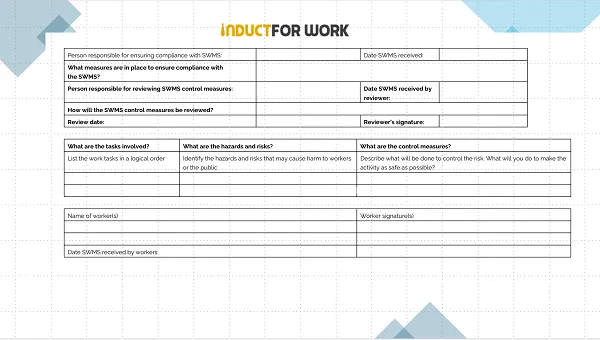
Free Safe Work Method Statement Template for Australian Workplaces
A Safe Work Method Statement, often called a SWMS, is one of the most important safety documents used in Australian construction, maintenance and high risk work environments.
A SWMS helps workers, contractors and site managers understand how a task will be completed safely. It outlines the work being performed, the hazards involved, the risks that may arise and the control measures that must be followed.
For businesses managing contractors, subcontractors or site-based workers, SWMS documents often work best when they are connected to a proper online induction software process. This helps make sure workers receive the right information, complete required forms and provide important safety documents before they arrive on site.
Download our free SWMS template and use it as a practical starting point for your next job, project or site activity.
What is a SWMS?
A Safe Work Method Statement is a safety document that explains how a work activity will be carried out safely.
It sets out:
- the work activity being performed
- the hazards connected with the work
- the risks that may affect workers or others
- the control measures used to reduce those risks
- the steps workers must follow
- the people responsible for checking that controls are in place
In simple terms, a SWMS is designed to make sure workers do not start high risk work without first understanding what could go wrong and how those risks will be controlled.
A good SWMS should be practical, clear and specific to the job. It should not be treated as a generic form that is completed once and forgotten. Work conditions can change, site layouts can change and new hazards can appear during the job.
That is why a SWMS should be reviewed whenever the work changes or when the control measures are no longer suitable.
Why are SWMS documents important?
SWMS documents are important because they help turn safety planning into clear instructions for workers and contractors.
Many incidents occur because workers are unsure about the correct process, the site conditions have changed or safety controls have not been properly explained. A SWMS helps reduce that risk by documenting the agreed method of work before the task begins.
For employers, principal contractors and site managers, SWMS documents can also help demonstrate that safety planning has taken place.
A well-managed SWMS process also supports stronger contractor management by helping businesses confirm that required documents, safety information and worker acknowledgements are collected before work begins.
A well-prepared SWMS can help with:
- contractor management
- site safety planning
- worker communication
- risk control
- audit preparation
- incident prevention
- proof that workers were given safety information
- record keeping for future reference
A SWMS is especially useful when several workers, trades or contractors are working in the same area. It creates a shared understanding of how the task should be completed safely.
When should a SWMS be used?
A SWMS is most commonly used for high risk construction work, but many organisations also use SWMS documents for other hazardous activities.
A SWMS may be required or requested for work involving:
- working at heights
- excavation
- demolition
- confined spaces
- electrical work
- working near roads or traffic
- working near mobile plant
- crane or lifting operations
- asbestos-related work
- structural alterations
- work near live services
- hot works
- roof work
- trenching
- use of hazardous substances
In many workplaces, contractors are asked to provide a SWMS before they arrive on site. This gives the site manager or principal contractor time to review the proposed work method and confirm that suitable controls are included.
For contractor-heavy workplaces, a structured contractor induction process can help make sure workers receive the correct site information before they arrive.
Even where a SWMS is not legally required for a specific task, it can still be useful for work that involves higher levels of risk.
What should a SWMS include?
A SWMS should be detailed enough to help workers understand the job but simple enough to be used on site.
A practical SWMS should usually include the following sections.
Job and company details
Include the project name, company name, site address, supervisor details, contractor details and the date the SWMS was prepared.
Description of the work
Describe the work activity clearly. Avoid vague wording such as “general site works”. A useful SWMS should explain exactly what work will be carried out.
Hazards and risks
List the hazards linked to the work. This may include falls, moving plant, electricity, confined spaces, hazardous substances, falling objects, unstable ground, traffic or manual handling risks.
Control measures
Explain how each risk will be controlled. This may include exclusion zones, permits, PPE, spotters, supervision, isolation procedures, signage, barriers, training or specific work methods.
Responsibilities
Identify who is responsible for supervising the work, checking controls and making sure workers follow the SWMS.
Worker acknowledgement
Workers should review and acknowledge the SWMS before starting the task. This helps confirm that the required safety information has been shared.
SWMS acknowledgements can also be supported with digital signatures, making it easier to prove who has reviewed and accepted the document.
Who should complete a SWMS?
A SWMS should be prepared by a competent person who understands the work, the site conditions and the risks involved.
This may include:
- a contractor
- a subcontractor
- a supervisor
- a site manager
- a safety officer
- a business owner
- a person responsible for planning the work
Workers who will carry out the task should also be consulted where possible. They often understand the practical risks of the job and can help identify controls that will actually work on site.
A SWMS should not be completed in isolation by someone who has no practical understanding of the work.
Common SWMS mistakes
Many SWMS documents fail because they are too generic, too long or not properly communicated to workers.
Common mistakes include:
- using the same SWMS for every job
- failing to update the SWMS when conditions change
- listing hazards without practical controls
- using vague wording
- not checking whether controls are in place
- not getting workers to review the SWMS
- storing SWMS documents in email inboxes or paper folders
- being unable to prove who has read and accepted the SWMS
A SWMS should be a working safety document, not just paperwork. It needs to be available, understandable and relevant to the actual job.
Using digital SWMS forms
Paper SWMS forms can work for small jobs, but they often become difficult to manage as the number of workers, contractors and sites grows.
Digital SWMS forms make it easier to:
- collect SWMS documents before work begins
- allow contractors to complete forms online
- capture worker acknowledgements
- store signed records securely
- track who has submitted required documents
- update forms when work methods change
- retrieve records during audits
- link SWMS documents to contractor inductions
Businesses can use custom forms to collect SWMS details, licences, permits, declarations and other contractor documents online.
For businesses managing several sites or many contractors, moving SWMS documents online can save time and reduce administration.
Instead of chasing paperwork, site managers can check whether the required documents have been submitted and accepted before work starts.
Managing SWMS with INDUCT FOR WORK
INDUCT FOR WORK helps Australian businesses manage contractor inductions, SWMS documents, licences, permits, forms and compliance records in one online system.
Contractors can complete their induction before arriving on site, upload required documents and acknowledge important safety information online. Administrators can track completion, review records and keep evidence ready for audits.
INDUCT FOR WORK gives businesses a practical contractor management system for managing inductions, SWMS records, document uploads, acknowledgements and compliance reminders in one place.
With INDUCT FOR WORK, you can manage:
- contractor inductions
- online training
- SWMS uploads
- digital forms
- licence and permit records
- policy acknowledgements
- visitor sign-ins
- incident reports
- compliance reminders
- site-specific requirements
This creates a much cleaner process than relying on paper forms, spreadsheets and email follow-ups.
For high risk work, having a reliable online record can make a major difference. You can see who has completed their induction, who has uploaded the required documents and who has accepted the relevant site rules before they begin work.
Frequently asked questions
No. A SWMS is mainly required for high risk construction work. However, many businesses also use SWMS documents for other hazardous tasks because they provide a clear record of how the work will be performed safely.
A generic SWMS template can be used as a starting point, but it should always be reviewed and adjusted for the actual task, site conditions, equipment, workers and risks involved.
Workers who are carrying out the task should review and acknowledge the SWMS before work begins. Supervisors or responsible persons may also sign or approve the document depending on the business process.
A SWMS should be reviewed whenever the work changes, site conditions change, new hazards are identified or control measures are no longer suitable.
Yes. Induct For Work can help businesses collect, store, review and track SWMS documents online. This is especially useful for contractor management, multi-site operations and audit preparation..
Start managing SWMS and contractor compliance online
A free SWMS template is a useful starting point, but managing workplace safety properly requires more than downloading a document.
Businesses need a reliable way to confirm that contractors have completed inductions, submitted the correct paperwork, acknowledged site rules and understood the risks before they begin work.
If your business regularly works with contractors, an online induction system for contractors can help reduce paperwork, improve record keeping and make site access easier to manage.
INDUCT FOR WORK makes this process easier by bringing inductions, SWMS records, online forms, licence uploads, compliance reminders and contractor records together in one platform.
Whether you manage a construction site, council facility, warehouse, manufacturing workplace, school, event site or large contractor workforce, INDUCT FOR WORK helps you reduce manual administration and keep better records.
Start with the free SWMS template, then move your contractor compliance process online with INDUCT FOR WORK.
Start a free trial or book a demo to see how INDUCT FOR WORK can support your workplace processes.
Author: Matt Tsashkuniats
Published: 12/08/2025
Last edited: 30/04/2026
Disclaimer
The SWMS provided is a sample only. Your SWMS must suit your site, your scope, your people and your plant. Write it with the construction contractor who will perform the high-risk activity, walk the area together and keep it live throughout the job. A short practical document that crews can follow is far better than a thick generic bundle.
If you want to manage this process without paper INDUCT FOR WORK can run multiple digital SWMS across jobs and sites with sign-off and records all in one place. Contact us today to discuss your SWMS requirements.