Online Inductions for Cleaning Contractors: Site Rules, Safety and Client Confidence
Cleaning work changes from site to site.
Cleaning contractors rarely work in one simple environment.
A cleaner may work in an office on Monday, a school on Tuesday, a medical centre on Wednesday, a warehouse on Thursday and a shopping centre over the weekend. Each site may have different keys, alarms, chemical storage points, waste rules, security expectations, toilets, kitchens, restricted areas, emergency procedures and reporting contacts.
That is why inductions for cleaning contractors need to be practical, site-aware and easy to repeat.
A cleaner can be experienced and still be new to a building.
The person may know how to mop, vacuum, disinfect, empty bins and clean bathrooms, yet still need to understand the client’s access rules, after-hours process, PPE expectations, sign-in method, sharps procedure, chemical register location and incident reporting steps.
INDUCT FOR WORK helps cleaning businesses and client sites deliver online induction, forms, acknowledgements, certificates, contractor records and incident reporting in one platform.
For the broader cleaner induction guide, see cleaning inductions. For contractor readiness across other trades and services, see contractor induction.
A structured process also supports a stronger safety culture because cleaners receive clear site instructions before work begins. In addition, rapid induction setup can help turn existing cleaning procedures, photos, site maps, checklists and client rules into online induction content sooner.
Why cleaning contractor induction is different
A cleaning contractor induction has to do more than explain cleaning tasks.
It also needs to explain how a contractor operates inside someone else’s workplace.
That changes the risk profile.
Cleaning contractors may:
- enter the site before staff arrive
- lock up after everyone leaves
- work while customers or residents are nearby
- use chemicals in shared spaces
- clean bathrooms, kitchens and high-touch surfaces
- handle unknown waste
- access restricted areas
- move between several client sites
- report hazards outside normal business hours
- work alone or in small teams
- carry keys, swipe cards or alarm codes
- manage urgent spills or contamination
- protect client property and privacy
A cleaning company may control its staff, equipment and procedures, but each client site still has its own rules.
Good induction connects those two worlds.
It tells cleaners how the cleaning company expects work to be done and how the client site expects people to behave while onsite.
A cleaner’s first shift should not depend on guesswork
Many cleaning problems start before the cleaner touches a mop.
The problem may begin when the cleaner is unsure where to park, which door to use, whether the alarm is active, where the chemical cupboard is, what waste stream applies, who to call after hours or whether a certain room is restricted.
A first-shift induction should answer practical questions:
- Where do cleaners enter?
- How is attendance confirmed?
- Which areas are included in the scope?
- What areas are out of bounds?
- Where are keys or access cards stored?
- How are alarms managed?
- What happens if access fails?
- Who receives urgent calls?
- Where are chemicals kept?
- Which hazards must be reported immediately?
- How should photos or notes be submitted?
- What happens before leaving the site?
Those questions look basic.
They are also the questions that prevent missed tasks, late starts, access problems, security issues and poor client experiences.
Site access, keys and alarms
Cleaning contractors often work when the building is quiet.
That makes site access one of the most important induction topics.
Access instructions may cover:
- permitted entry points
- car parking areas
- sign-in and sign-out process
- key collection
- swipe card use
- alarm codes
- lock-up procedure
- restricted areas
- visitor badges where required
- lift or loading dock access
- what to do if a door will not open
- who to contact if the alarm activates
- after-hours emergency number
Security rules should be written clearly.
A cleaner should not learn the alarm process from another worker’s memory. A missed step can lead to call-out fees, security concerns, client complaints and a poor start to the shift.
Where client sites differ, each site should have its own short access module.
Scope of work and client standards
A contractor cleaner needs to understand what work is included and what is not included.
This matters because expectations vary.
A standard office clean may include kitchens, toilets, bins, vacuuming and desks. A medical site may need high-touch surfaces, infection control steps and waste separation. A school may require classroom routines and child-safety expectations. A retail site may focus on presentation, spills and public access.
An induction can explain:
- daily tasks
- weekly tasks
- periodic tasks
- excluded areas
- client quality standards
- photos required after completion
- escalation process
- missed-work reporting
- damage reporting
- consumable restocking
- supervisor review process
Clear scope reduces disputes.
A cleaner should know when to complete the task, when to report an issue and when to stop and ask before doing extra work.

Chemical safety across client sites
Cleaning contractors often use chemicals across different buildings.
Some products are supplied by the cleaning company. Others may be supplied by the client. Product types, storage locations and dilution systems may vary.
A contractor induction should explain:
- approved chemicals
- product labels
- dilution rules
- PPE requirements
- safety data sheet access
- chemical storage locations
- spill response
- ventilation requirements
- first aid steps
- what not to mix
- disposal rules
- who to contact after exposure
Safe Work Australia says a person conducting a business or undertaking must ensure hazardous chemicals are correctly labelled and must maintain a register of hazardous chemicals used, handled or stored at the workplace.
The induction should not only say “follow the SDS”.
It should tell cleaners where the SDS or chemical register can be found and what to do when the correct product is missing.
Slips, trips and wet floors
Cleaning both finds and creates slip risks.
A cleaner may arrive to a spill, then create a wet surface while mopping, scrubbing, polishing or using a floor machine.
Controls should be practical.
A cleaning contractor induction should explain:
- when warning signs are required
- where signs are stored
- how to manage wet areas near the public
- which surfaces become slippery
- how cords should be placed
- when an area needs to be blocked off
- what footwear is required
- how to report damaged flooring
- what to do if someone slips
Safe Work Australia lists wet or greasy floors, obstacles, uneven edges, loose mats and cables as common causes of slips, trips and falls.
A wet floor sign may help, but it does not remove every risk.
Timing, barriers, supervision, cleaning sequence and public movement all matter.
Manual tasks and equipment movement
Cleaning work can involve repeated movement every shift.
Tasks may include:
- lifting vacuum cleaners
- pushing trolleys
- carrying buckets
- moving bins
- changing rubbish bags
- handling floor machines
- moving furniture
- reaching high surfaces
- scrubbing bathrooms
- loading supplies
- carrying chemicals
- pulling hoses or extension leads
A useful induction should explain how equipment is moved at that site.
For detailed guidance, see manual handling online induction.
Practical controls may include smaller loads, trolleys, safer storage heights, team lifting, better equipment placement and early reporting of discomfort.
A cleaner should not be expected to carry heavy supplies across a car park simply because no one planned storage properly.
Sharps, broken glass and unknown waste
Cleaning contractors may find waste that other people failed to handle properly.
That can include:
- broken glass
- needles
- razors
- sharp metal
- exposed nails
- broken crockery
- contaminated tissues
- food waste
- chemical containers
- damaged equipment
- unknown liquids
- discarded personal items
An induction should tell cleaners what they should not touch.
It should also explain:
- how to report sharps
- where approved containers are located
- when gloves or tools are required
- what happens after a needle-stick injury
- how broken glass is collected
- which waste streams apply
- what to do with unknown substances
- who approves removal of unusual items
Cleaners often work in bathrooms, public spaces, change rooms, car parks and bins.
That makes waste handling a serious topic, not a minor task note.
Stronger control and high-touch cleaning
Some client sites need stronger hygiene procedures.
This may apply to:
- medical centres
- aged care sites
- childcare centres
- schools
- gyms
- accommodation
- food areas
- public venues
- shared amenities
- transport facilities
Cleaner induction may cover:
- hand hygiene
- glove use
- high-touch points
- colour-coded cloths
- cleaning sequence
- bathroom routines
- contamination control
- waste handling
- disinfectant contact time
- equipment cleaning
- illness reporting
- site-specific PPE
For wider care-sector induction guidance, see health and aged care online induction.
Infection control should be explained in plain steps.
A cleaner needs to know what to do in the room, not only read a policy title.
Working alone and after-hours cleaning
Many cleaners work alone or outside standard operating hours.
This changes the safety and communication needs.
The induction should explain:
- check-in process
- expected start and finish times
- after-hours contact number
- emergency escalation
- duress process where available
- unsafe behaviour response
- lighting issues
- lock-up procedure
- vehicle parking
- working in isolated areas
- what to do if a person remains onsite
- how to report concern before leaving
A cleaner should not need to decide alone whether a situation is safe.
Clear escalation steps are especially important for late-night, early-morning and remote-area work.
Privacy, property and client trust
Cleaning contractors often enter spaces where people keep personal items, business records, devices and confidential information.
The induction should cover:
- privacy expectations
- photographs and phones
- lost property
- personal belongings
- client documents
- computer screens
- keys and access cards
- locked rooms
- damage reporting
- conduct around staff or visitors
This is not only about safety.
It is about trust.
A cleaning contractor may lose a client because of poor communication, unclear boundaries or mishandled property, even where the cleaning work itself was acceptable.
Communication and issue reporting
Cleaners often see problems first.
A cleaner may notice leaks, damage, blocked exits, pests, broken glass, unsafe cords, aggressive behaviour, security issues, overflowing bins or signs of forced entry.
The induction should explain what must be reported and how quickly.
Useful reporting categories include:
- injury
- near miss
- hazard
- property damage
- security concern
- chemical exposure
- biological hazard
- equipment fault
- access issue
- missed scope
- client complaint
- unsafe behaviour
- privacy concern
INDUCT FOR WORK supports incident reporting so cleaning businesses can capture hazards, near misses and incidents online.
For practical reporting examples, see incident report examples.
A reporting process should work during the shift, not only during office hours.
Site-specific modules reduce confusion
Cleaning contractor induction works best when it separates common training from site-specific information.
A practical structure may look like this:
| Module type | Purpose |
|---|---|
| Core cleaning induction | Company expectations, general safety and reporting |
| Client site module | Access, scope, contacts, alarms and restricted areas |
| Chemical module | Product use, SDS access, PPE and spill response |
| Role module | Office, school, medical, gym, retail or construction cleaning |
| Refresher module | Updates after product, site or procedure changes |
| Supervisor module | Quality checks, escalation and record review |
This structure stops every cleaner from receiving one oversized course.
It also helps cleaning businesses keep common rules consistent while adjusting site details.
For broader pathway planning, see role-specific work induction.
Document collection for cleaning contractors
Some client sites may ask cleaning contractors for documents before work begins.
These may include:
- public liability insurance
- workers compensation evidence
- company details
- worker details
- police checks where suitable
- working with children checks where required
- chemical safety information
- SDS records
- training certificates
- licence records where relevant
- site acknowledgements
- contractor declarations
For broader contractor document review, see contractor compliance documents.
Document collection should match the work and site risk.
A medical site, school, council building and commercial office may each require different evidence.
Forms and acknowledgements
Cleaning contractor induction often needs more than training slides.
It may need forms and sign-offs such as:
- emergency contact form
- key holder acknowledgement
- alarm code acknowledgement
- PPE acknowledgement
- chemical safety acknowledgement
- privacy acknowledgement
- incident reporting acknowledgement
- client site rules acknowledgement
- contractor declaration
- equipment use acknowledgement
- after-hours work acknowledgement
With custom forms and digital signatures, cleaning businesses can collect these online and keep them linked to the contractor record.
This reduces paper handling and gives managers clearer proof of what was completed.
Quizzes and checks for understanding
A quiz should confirm that cleaners understand practical site rules.
Good questions may cover:
- which door to use
- when to set the alarm
- where chemicals are stored
- how to report a spill
- what to do if a sharp is found
- when warning signs are required
- who to contact after hours
- which areas are restricted
- what PPE applies to a task
- how to report damage
Questions should be short and practical.
The aim is not to trick the cleaner.
It is to confirm that important instructions were understood before the first shift.
Refresher training for cleaning contractors
Cleaning contractor induction should be refreshed when site conditions change.
Refresher training may be useful when:
- chemicals change
- cleaning scope changes
- alarm process changes
- site access changes
- client contacts change
- waste streams change
- equipment changes
- incident trends appear
- cleaners return after time away
- contractor documents expire
- infection control requirements change
- new high-risk areas are added
Auto reinvite can help cleaning businesses assign repeat training, renew acknowledgements and update modules.
A refresher process helps stop old instructions from staying in circulation after the site has changed.
Records that help win and keep contracts
Cleaning contractors often need proof.
A client may ask whether cleaners have completed site induction, acknowledged procedures, supplied documents or received updated instructions.
Useful records may include:
- induction completion date
- site module assigned
- quiz result
- certificate issued
- forms submitted
- PPE acknowledgement
- chemical safety acknowledgement
- incident reporting acknowledgement
- document uploads
- refresher status
- supervisor review notes
- records needing follow-up
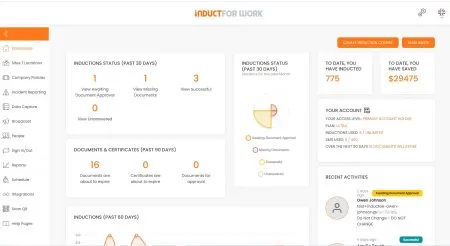
INDUCT FOR WORK helps improve record keeping by keeping training records, forms, certificates and acknowledgements online.
In addition, reporting helps managers review completion status and follow up where needed.
Clear records can help during audits, client reviews, tenders and contract renewals.
A better rollout plan for cleaning contractors
A practical rollout can be simple.
| Stage | What to do |
|---|---|
| Map the client sites | List access rules, contacts, risks and scope for each site |
| Build one core course | Cover company expectations, safety, chemicals and reporting |
| Add short site modules | Include entry points, alarms, waste, restrictions and contacts |
| Create role pathways | Separate medical, office, school, retail or construction cleaning |
| Collect forms online | Link declarations, acknowledgements and uploads to the user |
| Add practical quizzes | Check understanding of key site rules |
| Review completion reports | Follow up missing users before work begins |
| Refresh after changes | Update modules when products, rules or sites change |
This approach keeps the induction manageable.
It avoids one giant course while still giving each cleaner the information they need.
Common cleaning contractor induction mistakes
Treating all sites the same
Client sites can have different access, risk and reporting rules.
Leaving alarm rules informal
Keys, swipe cards and alarm codes need clear instructions.
Hiding chemical information
Cleaners should know where product instructions and SDS details can be found.
Forgetting after-hours work
Working alone needs proper contact and escalation steps.
Making the course too generic
A cleaner needs instructions that match the building, role and task.
Ignoring client trust
Privacy, lost property, damage reporting and conduct all matter.
Keeping records scattered
Forms, certificates and acknowledgements should stay easy to find.
Waiting for complaints
Near misses, hazards and repeated questions should improve the induction earlier.
Best practice tips for cleaning contractor inductions
Start with the site
Access, alarms, scope and contacts should be clear before the first shift.
Keep the core course short
Cover common cleaning rules once, then add site modules.
Use real site photos
Images of entry points, chemical areas and waste locations reduce confusion.
Separate cleaner roles
Medical, school, office, gym and construction cleaning may require different pathways.
Make reporting immediate
Cleaners should know how to report hazards, damage and security concerns during the shift.
Record key acknowledgements
Site rules, privacy, chemical safety and after-hours requirements should be signed off.
Refresh after changes
Update training when products, procedures, contacts or access rules change.
Review completion before work
Managers should confirm induction completion before assigning the cleaner to the site.
Start improving cleaning contractor induction
Cleaning contractors need more than general cleaning instructions.
They need site access details, client expectations, chemical safety, waste rules, after-hours procedures, privacy standards, reporting steps and clear records before the first shift.
INDUCT FOR WORK helps cleaning businesses deliver contractor inductions online, assign site-specific modules, collect forms, capture acknowledgements, issue certificates, support incident reporting and keep records in one platform.
For the broader cleaner induction page, see cleaning inductions. For contractor readiness, see contractor induction. For wider training management, see LMS for workplace training.
Give cleaning contractors clearer site instructions before they arrive.
Frequently asked questions
Inductions for cleaning contractors are training pathways that prepare cleaners before they work at a client site. They explain access rules, cleaning scope, chemical safety, waste handling, emergency steps, reporting and site expectations.
Cleaner inductions focus on general cleaning work. Cleaning contractor inductions also cover client site access, keys, alarms, restricted areas, document requirements and contractor records.
It should include site access, sign-in process, alarm rules, emergency procedures, chemical safety, slips and trips, waste handling, infection control, privacy, incident reporting and client expectations.
Induct For Work online inductions reduce scheduling pressure, help standardise training across shifts, and produce clear records that support client requirements and audits.
Yes. Induction portals allow self registration through a unique URL which can be shared or embedded.
Yes. Refresher training may be needed when chemicals, access rules, client contacts, cleaning scope, equipment or site procedures change.
Often, yes. A core cleaning induction can cover common rules while a short site module explains local access, alarms, hazards, scope and contacts.
Start a free trial or book a demo to see how INDUCT FOR WORK can support your workplace processes.
Author: Anna Milova
Published: 06/11/2018
Updated: 27/05/2026