Induction vs Induct: What Each Word Means in Workplace Onboarding
What each word means in workplace onboarding
The words induction and induct are closely related, but they are not used in the same way.
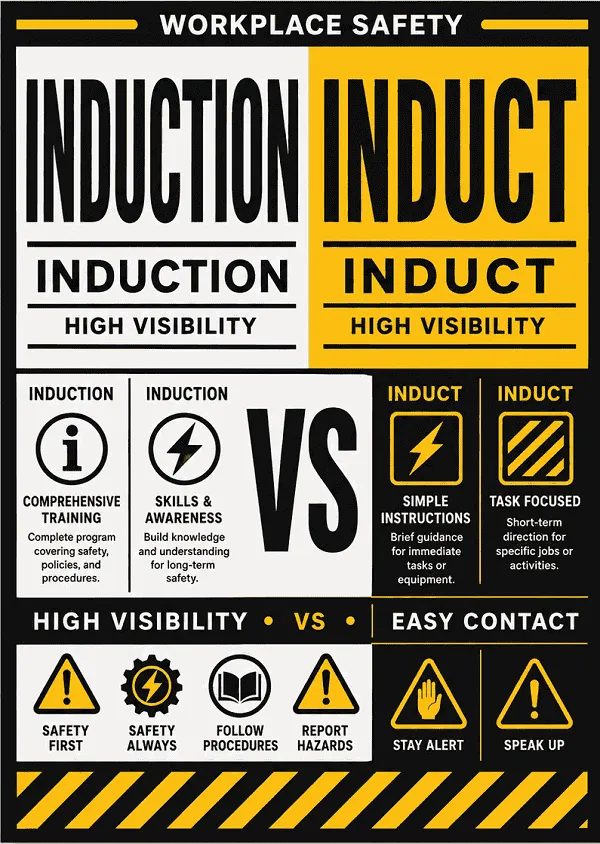
In workplace onboarding, induction is usually the noun. It refers to the process, program or training that introduces a new person to the workplace.
Induct is the verb. It refers to the action of putting someone through that process.
For example:
We need to complete the employee induction before the first shift.
And:
We need to induct the new employee before the first shift.
Both sentences are related, but they use different word forms.
Understanding the difference helps managers, HR teams and supervisors write clearer training instructions, onboarding material and workplace documents.
INDUCT FOR WORK helps organisations deliver online induction, onboarding training, forms, acknowledgements, certificates, incident reporting and records in one platform. For broader training management, INDUCT FOR WORK can also support an LMS for workplace training structure where induction, refresher training, quizzes, certificates and records sit together.
A structured induction process also supports a stronger safety culture because new workers receive clear instructions before they begin. In addition, rapid induction setup can help organisations turn existing policies, safety rules, videos and checklists into online training sooner.
What does induction mean?
In a workplace setting, induction means the process of introducing a new person to the workplace, role, rules and expectations.
An induction may explain:
- workplace rules
- emergency procedures
- safety responsibilities
- role expectations
- site access
- PPE requirements
- incident reporting
- policy acknowledgements
- supervisor contacts
- required forms
- training steps
- certificates and records
A workplace induction may happen before the first shift, on the first day or as part of a broader onboarding process.
For a broader explanation, see induction.
In simple terms, induction is the thing being completed.
Examples:
The induction must be completed before work begins.
Our contractor induction includes emergency procedures and site rules.
The online induction gives new workers the information they need before arrival.
What does induct mean?
Induct is the action word.
To induct someone means to introduce them formally into a workplace, role, organisation, site or system.
Examples:
We will induct the new cleaner before the first shift.
Supervisors must induct contractors before they enter the work area.
The company needs to induct seasonal workers before harvest begins.
In simple terms, induct is the action of putting someone through an induction.
A manager may induct a worker.
A business may induct contractors.
A system may help induct new starters online.
However, in everyday workplace writing, many people use “complete induction” more often than “induct”. Both can be correct when used properly.
Induction is a noun
A noun names a thing, process or concept.
In workplace language, induction is the process or training program.
Use induction when referring to the process, course or record, such as:
- workplace training before a person starts
- an onboarding course for new employees
- a first-day workplace introduction
- site-specific training before access is granted
- a contractor induction pathway
- a safety training module
- a completion record
- an induction certificate
Correct examples:
Please complete your induction before attending site.
The induction covers safety rules, emergency procedures and incident reporting.
Each worker receives an induction certificate after completion.
The contractor induction must be renewed every year.
Incorrect example:
Please induct before attending site.
Better:
Please complete your induction before attending site.

Induct is a verb
A verb describes an action.
Use induct when someone or something is doing the action of introducing a person to the workplace.
Correct examples:
We need to induct three new employees today.
The supervisor will induct the contractor before work starts.
The company uses online training to induct workers before arrival.
Managers should induct workers before assigning high-risk tasks.
Incorrect example:
The employee must finish their induct.
Better:
The employee must finish their induction.
How this applies to onboarding
Onboarding is the broader process of helping a new starter settle into the organisation.
It may include recruitment steps, employment paperwork, payroll setup, system access, induction, training, manager check-ins and role development.
Induction is one part of onboarding.
For a broader new-starter guide, see onboarding.
A simple way to think about it:
| Term | Meaning |
|---|---|
| Onboarding | The broader journey of bringing someone into the business |
| Induction | The formal introduction to workplace rules, safety and expectations |
| Induct | The action of taking someone through that introduction |
A business may onboard a new employee over several weeks.
The same business may induct that employee before the first shift.
The employee may complete an induction as part of that onboarding process.
Workplace examples
Employee onboarding
A new employee joins the business.
The onboarding process may include:
- employment contract
- payroll setup
- system access
- workplace induction
- role training
- manager introduction
- first-week check-in
In this case, induction is one part of onboarding.
Correct wording:
The new employee will complete induction before starting work.
The manager will induct the employee during the first-day session.
The onboarding process continues after induction is complete.
Contractor site access
A contractor arrives to perform work at a site.
The contractor may need:
- site induction
- emergency instructions
- PPE rules
- document uploads
- insurance records
- licence checks
- incident reporting instructions
- acknowledgement of site rules
For contractor-specific readiness, see contractor induction.
Correct wording:
Contractors must complete their induction before site access.
The site manager will induct contractors before work begins.
Inducted contractors may receive a completion certificate.
Safety training
A worker needs to understand workplace safety rules.
The induction may include:
- hazards
- emergency procedures
- PPE
- incident reporting
- manual handling
- equipment rules
- restricted areas
For safety-specific pathways, see online safety induction.
Correct wording:
Safety induction should happen before the worker begins the task.
The supervisor must induct workers on site-specific hazards.
Workers who have been inducted should still receive refresher training when procedures change.

Common mistakes with induction and induct
Using “induct” as a noun
Incorrect:
Please complete your induct.
Correct:
Please complete your induction.
Using “induction” as a verb
Incorrect:
We need to induction the new workers.
Correct:
We need to induct the new workers.
Better in many workplace settings:
We need to complete induction for the new workers.
Making the sentence too formal
Formal:
The organisation shall induct all personnel prior to commencement.
Clearer:
Workers must complete induction before they start.
Forgetting who is doing the action
Unclear:
The workers will be inducted.
Clearer:
The supervisor will induct the workers before they enter the site.
Or:
Workers will complete induction online before arriving.
Treating onboarding and induction as identical
Onboarding is broader.
Induction is usually one structured part of onboarding.
Which word should you use on a workplace page?
For website copy, training instructions and onboarding emails, induction is usually the stronger word.
It is clearer for most readers because it describes the process they need to complete.
Use phrases such as:
- employee induction
- workplace induction
- contractor induction
- safety induction
- site induction
- online induction
- induction training
- induction certificate
- induction records
- induction pathway
Use induct when describing the action performed by the organisation, manager or supervisor.
Examples:
We induct new workers before they begin.
Supervisors are responsible for inducting contractors.
The platform helps businesses induct workers online.
For user-facing instructions, “complete your induction” is usually clearer than “be inducted”.
Better wording for common workplace messages
| Weak Wording | Better Wording |
|---|---|
| You must induct before starting. | You must complete your induction before starting. |
| Complete your induct today. | Complete your induction today. |
| We induction all staff. | We induct all staff before they begin work. |
| Staff onboarding and induction are the same. | Induction is one part of the broader onboarding process. |
| The induct covers safety. | The induction covers safety rules and emergency procedures. |
| Once inductioned, you can start. | Once inducted, you can start. |
| The worker was inductioned yesterday. | The worker was inducted yesterday. |
| Induct must be done yearly. | Induction must be completed yearly. |
Plain wording helps new workers, contractors and managers understand what needs to happen next.
How induction fits into a training program
A good induction should not sit alone.
It may connect with:
- onboarding
- role-specific training
- safety training
- refresher training
- contractor readiness
- visitor management
- incident reporting
- document collection
- policy acknowledgement
- certificates and records
For planning structured training pathways, see online induction program.
A new starter may complete induction first, then complete role-specific modules over time.
A contractor may complete site induction, upload documents and acknowledge important rules before arrival.
A manager may review completion records before allowing access to a work area.
Why clear terminology matters
Small wording choices can affect how people understand instructions.
If a message says “complete your induct”, a new worker may still understand the intent, but the wording looks awkward and unprofessional.
Clear language matters in:
- emails
- induction invitations
- onboarding checklists
- training portals
- HR documents
- contractor instructions
- safety procedures
- completion certificates
- reminder messages
- policy acknowledgements
Workers should not need to decode the instruction.
They should know exactly what to complete, by when and where to go for help.
For workers who may need clearer wording or visual support, see induction for non-English-speaking workers.
Writing induction instructions clearly
Good induction instructions should be simple.
They should explain:
- what the person needs to complete
- why it matters
- when it must be done
- which pathway applies
- what documents are needed
- who to contact
- what happens after completion
Examples:
Please complete your online induction before arriving on site.
Your induction covers emergency procedures, site rules and incident reporting.
Once you complete the induction, your manager will review your record.
Contractors must upload required documents before site access is approved.
New starters should complete their induction before the first shift.
These sentences are direct and easy to understand.
They also avoid awkward wording such as “complete your induct”.
Inducted, inducting and induction records
The related word forms are also useful.
Inducted
Use inducted when the person has already gone through the induction process.
Examples:
The contractor was inducted before entering the site.
Only inducted workers may access the work area.
The system shows which users have been inducted.
Inducting
Use inducting when the process is happening now.
Examples:
The supervisor is inducting new employees.
The business is inducting seasonal workers this week.
The site manager is inducting contractors before the project begins.
Induction records
Use induction records for the evidence of completion.
Records may include:
- completion date
- assigned pathway
- quiz result
- certificate
- signed acknowledgements
- forms submitted
- documents uploaded
- refresher due date
For broader records guidance, see record keeping.
Digital induction and records
Online systems make the induction process easier to manage.
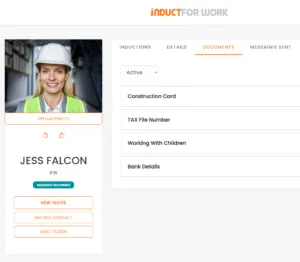
Instead of relying on paper forms, repeated briefings or spreadsheet tracking, organisations can assign induction pathways, collect forms, issue certificates and review completion reports online.
INDUCT FOR WORK helps organisations manage:
- employee induction
- contractor induction
- visitor induction
- safety induction
- role-specific training
- refresher training
- policy acknowledgement
- document uploads
- forms
- certificates
- incident reporting
- completion records
For broader reporting guidance, see reporting.
The terminology still matters.
The system helps organisations prepare workers before they start.
The person completes an induction.
The manager reviews induction records.
Common workplace phrases and how to use them
“Complete induction”
This is usually the clearest phrase for workers.
Example:
Please complete induction before your first shift.
“Induct new employees”
This suits manager-facing language.
Example:
Managers must induct new employees before they begin work.
“Employee induction”
This refers to the process or course.
Example:
Employee induction includes workplace rules, safety procedures and role expectations.
“Inducted worker”
This describes someone who has completed the process.
Example:
Only inducted workers may enter the restricted area.
“Induction certificate”
This refers to proof of completion.
Example:
Your induction certificate will be available after you pass the quiz.
“Onboarding induction”
This phrase can be used, but it may be clearer to say:
Induction is part of onboarding.
Best practice tips for induction wording
Use induction for the process
Refer to the course, training or pathway as induction.
Use induct for the action
Use induct when someone is putting a worker through the process.
Keep worker instructions simple
“Complete your induction” is clearer than “be inducted”.
Separate onboarding from induction
Onboarding is broader and may continue after induction.
Avoid invented word forms
Avoid invented forms such as “inductioned”, “induct training” or “complete your induct”.
Make the deadline clear
Tell workers when induction must be completed.
Match the role
Contractors, employees and visitors may need different pathways.
Keep records easy to find
Completion certificates and acknowledgements should remain accessible.
Start using clearer induction language
Induction and induct are closely related, but they are not interchangeable.
Induction is the process.
Induct is the action.
A worker completes an induction.
A manager may induct a worker.
An organisation keeps induction records after the process is complete.
Clear wording helps new starters, contractors, supervisors and administrators understand what needs to happen before work begins.
INDUCT FOR WORK helps organisations deliver induction online, assign role-specific pathways, collect forms, capture acknowledgements, issue certificates and keep records in one platform.
For broader onboarding guidance, see onboarding. For structured workplace readiness, see work induction. For wider training management, see LMS for workplace training.
Give workers clearer instructions before their first shift begins.
Frequently asked questions
nduction is the process, program or training. Induct is the action of taking someone through that process.
For worker instructions, “complete induction” is usually clearer. “Be inducted” is correct, but it sounds more formal.
No. Onboarding is the broader new-starter journey. Induction is usually one structured part of onboarding.
No. The correct phrase is usually “online induction” or “online induction training”.
Inducted means a person has gone through the induction process. For example: “The contractor was inducted before entering site.”
Yes. INDUCT FOR WORK can help organisations assign induction pathways, collect forms, issue certificates and keep completion records online.
Author: Matt Tsashkuniats
Published: 29/05/2026
Updated: 29/05/2026