Police Checks Before Employment: What Employers Should Know Before Work Starts
How police checks, induction and workplace readiness fit together
A police check may form part of a pre-employment, volunteer, contractor or licensing process.
Some employers request police checks because the role involves trust, vulnerable people, regulated work, finance, security, sensitive information, site access or customer-facing duties. Other organisations may need them because a client, regulator, licence condition or industry requirement asks for one.
A police check does not train someone for the job.
It helps verify certain criminal history information that may be relevant to a role. Once the employer has reviewed the result and decided that the person can proceed, the next step is usually onboarding, induction, training, forms and workplace readiness.
INDUCT FOR WORK helps organisations manage the steps that often come before and after screening: online induction, training, forms, document uploads, acknowledgements, certificates, incident reporting and records. For broader training management, INDUCT FOR WORK can also support an LMS for workplace training structure where induction, refresher training, quizzes, certificates and records sit together.
A structured onboarding and induction process also supports a stronger safety culture because new workers receive clear instructions before work begins. In addition, rapid induction setup can help organisations turn policies, role requirements, onboarding instructions and site rules into online training sooner.
What is a police check?
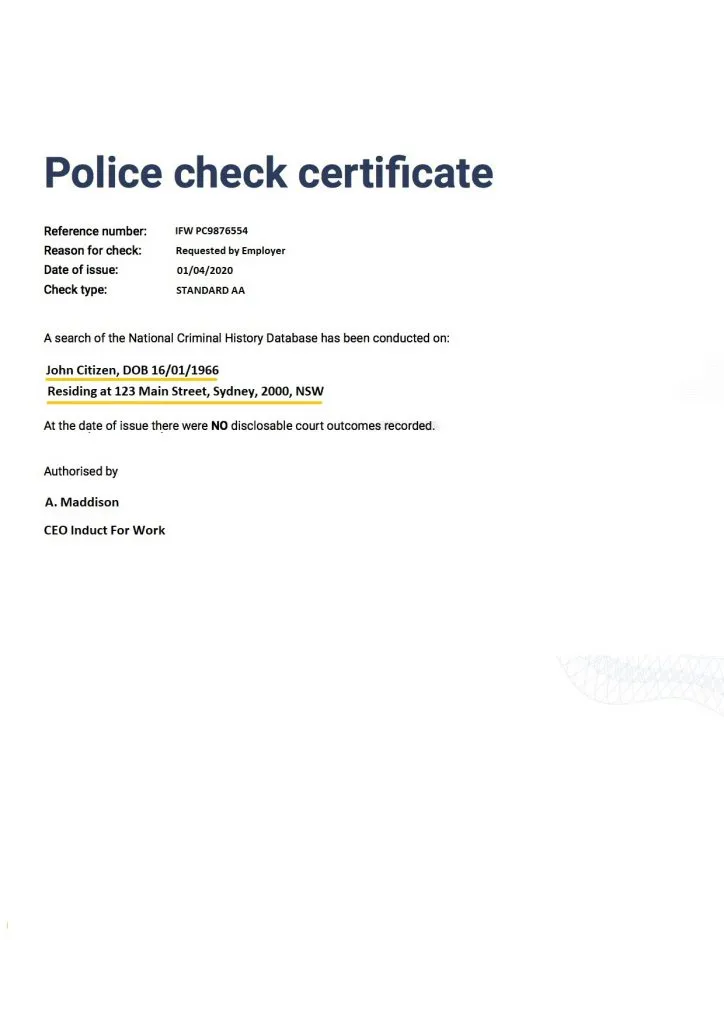
A police check is a process that reviews certain police history information and produces a certificate or result that may be used for a stated purpose.
In Australia, a National Police Certificate is sometimes called a national police check. The Australian Federal Police explains that a National Police Certificate is a summary of a person’s offender history in Australia and may be needed for recruitment and job applications, among other purposes.
Victoria Police explains that a National Police Certificate contains disclosable court outcomes from Australian states and territories that are relevant to the purpose of the check. Victoria Police also notes that employers, organisations and regulators may request a National Police Certificate to help assess suitability for employment, volunteering, student placement, licensing and registration.
In practical terms, the check should match the reason it is being requested.
A police check for general employment may not be the same as a check required for a specific licence, regulated role or government purpose.
When employers may request police checks
Employers may request police checks where the role makes them relevant.
This may include roles involving:
- children or vulnerable people
- aged care or health services
- education settings
- financial responsibility
- security duties
- access to private homes
- sensitive customer information
- government contracts
- regulated licensing
- high-trust positions
- unsupervised work
- site access requirements
- cash handling
- confidential records
- contractor access to restricted areas
A police check should not be used simply because it is convenient.
The check should relate to the work, access level and risk profile.
For broader screening topics beyond police checks, see background checks before employment.
Police checks and consent
Police checks involve personal information.
Employers should explain why the check is required, what type of check is needed, how the result will be used and who will have access to the record.
A practical process should cover:
- candidate or worker consent
- reason for the check
- role or purpose of the check
- screening provider or official service used
- identity requirements
- privacy handling
- review process
- decision-making responsibility
- secure storage
- expiry or review date where relevant
Workers should not be surprised by a police check.
The request should be transparent and connected to the role.
Where police checks are obtained
Police checks should be obtained through official services or suitable accredited screening providers.
The Australian Federal Police states that applicants must use the AFP if the request is for Commonwealth or ACT reasons.
Victoria Police provides a National Police Check process for use in Victoria and explains that applicants receive a National Police Certificate as a result of the check.
Employers should confirm which service applies to the purpose, state, role and industry.
Some checks may need to be requested directly by the individual. Others may be managed through an authorised organisation or accredited provider.
Police checks are not the same as Working With Children Checks
A police check and a Working With Children Check are not the same thing.
A police check provides information about disclosable police history for the stated purpose.
A Working With Children Check is a separate screening process for people who work with children in roles covered by the relevant state or territory scheme.
Some roles may require both.
Employers should not assume that one replaces the other. They should check the exact legal or industry requirement for the role.
Police checks are not the same as background checks
A police check is one type of background check.
A broader background-check process may also include:
- identity checks
- work rights checks
- qualification checks
- employment history checks
- reference checks
- licence checks
- traffic history checks where relevant
- professional registration checks
- international checks where relevant
- contractor document review
For a broader guide, see background checks before employment.
A police check should sit inside a role-relevant screening process, not replace every other check.
Police checks and onboarding
Police checks often happen before onboarding or early in the onboarding process.
A practical workflow may look like this:
- employer identifies whether the role needs a police check
- candidate or worker receives clear instructions
- consent is obtained
- check is completed through the correct channel
- result is reviewed by an authorised person
- decision is recorded
- induction pathway is assigned
- forms and acknowledgements are completed
- role-specific training begins
- certificates and records are stored
For broader onboarding guidance, see onboarding.
The screening result may help decide whether the person can proceed. Induction explains what they need to know once they are ready to begin.
Police checks and contractor readiness
Contractors may also need police checks in some settings.
This may apply when contractors enter schools, care facilities, government sites, restricted workplaces, private homes, sensitive facilities or client-controlled locations.
Contractor readiness may also involve:
- company details
- worker details
- licences
- insurance documents
- trade certificates
- site induction
- policy acknowledgements
- emergency procedures
- incident reporting
- access rules
- completion certificates
For contractor-specific workflows, see contractor pre-qualification and contractor induction.
INDUCT FOR WORK can help collect contractor documents, assign induction and keep completion records online after screening requirements are handled elsewhere.
How employers should assess police check results
A police check result should be handled carefully.
A result does not always mean a person is unsuitable for a role.
Employers should consider:
- relevance to the role
- seriousness of the matter
- how long ago it occurred
- whether the role involves similar risk
- legal or industry requirements
- whether restrictions apply
- whether the person had a chance to respond
- privacy and confidentiality
- consistency in decision-making
- documented review process
Employers should seek proper advice where decisions may affect employment, volunteering, licensing or site access.
This page gives general information only and does not provide legal advice.
What records should employers keep?
The records kept will depend on the role, industry and legal requirements.
Useful records may include:
- consent confirmation
- check type
- purpose of the check
- date requested
- date received
- screening provider or official service used
- decision outcome
- expiry or review date where relevant
- induction assigned after approval
- training completion
- policy acknowledgements
- certificates issued
- manager review notes
Employers should avoid storing more sensitive information than they need.
In many cases, a secure record that a check was completed and reviewed may be more appropriate than keeping unnecessary detail.
For broader training and induction records, see record keeping.
Police checks and role-specific training
A person may pass a police check and still need job-specific instruction.
For example:
- a school contractor still needs site access rules
- an aged care worker still needs induction and procedures
- a finance employee still needs privacy and cybersecurity training
- a driver still needs vehicle and site instructions
- a cleaner still needs chemical and after-hours access rules
- a remote worker still needs work-from-home expectations
For tailored training pathways, see role-specific work induction.
A police check may support suitability. Induction supports readiness.
Training after a police check
Once the employer has decided the person can proceed, training should begin before work starts.
Training may include:
- workplace induction
- safety procedures
- emergency response
- privacy and confidentiality
- cybersecurity awareness
- incident reporting
- workplace conduct
- role-specific training
- contractor site rules
- work-from-home expectations
- policy acknowledgements
For broader training delivery, see online training.
The worker should understand the actual workplace, not just pass screening.
Using forms and acknowledgements carefully
Police-check processes and onboarding may require forms.
These may include:
- consent forms
- privacy acknowledgements
- role declarations
- contractor declarations
- licence upload forms
- qualification upload forms
- policy acknowledgements
- induction completion confirmations
- site access forms
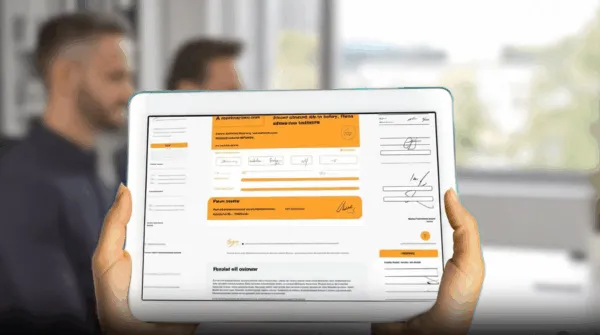
With custom forms and digital signatures, employers can collect onboarding and induction information online.
These tools should be used for training, document collection and acknowledgements around work readiness.
The police check itself should still be handled through the employer’s chosen official service, screening provider or internal HR process.
How INDUCT FOR WORK supports the process after checks
NDUCT FOR WORK helps employers manage the readiness steps that come after police checks are handled elsewhere.
It can support:
- online induction
- onboarding forms
- document uploads
- policy acknowledgements
- role-specific training
- contractor induction
- quizzes
- certificates
- incident reporting
- refresher training
- completion reports
- record keeping
It does not conduct police checks.
Employers should use the correct official service, accredited provider or internal screening process for police checks.
INDUCT FOR WORK then helps deliver training, collect acknowledgements and keep induction records once the person is ready to proceed.
Common police check mistakes
Requesting checks without a clear reason
A police check should be relevant to the role, access level or legal requirement.
Treating every result the same way
Employers should consider relevance, timing, role duties and legal obligations.
Failing to explain the process
Candidates and workers should understand why the check is required.
Storing unnecessary sensitive details
Keep records secure and avoid retaining information that is not needed.
Forgetting induction after screening
A police check does not explain workplace rules, safety procedures or reporting steps.
Ignoring contractors
External workers may need screening and induction before site access.
Letting records sit in emails
Induction, acknowledgements and training records should stay easy to find.
From police check to work readiness
| Screening Step | Readiness Step |
|---|---|
| Police check requirement identified | Explain the reason and obtain consent |
| Check completed through proper channel | Review the result through the employer’s process |
| Worker approved to proceed | Assign the correct induction pathway |
| Role involves sensitive access | Add privacy and conduct training |
| Contractor needs site access | Assign contractor induction |
| Worker handles customer data | Add cybersecurity and privacy modules |
| Role involves safety requirements | Assign safety induction |
| Training completed | Keep certificates and acknowledgements |
| Records reviewed | Follow up missing items before work begins |
This keeps screening separate from induction while making the overall process easier to manage.
Best practice tips for police checks and induction
Match the check to the role
Only request a police check where it is relevant or required.
Explain the purpose
Workers should know why the check is being requested.
Use the correct channel
Use the proper official service, accredited provider or internal process.
Control access to results
Sensitive information should only be available to people who genuinely need it.
Separate screening from training
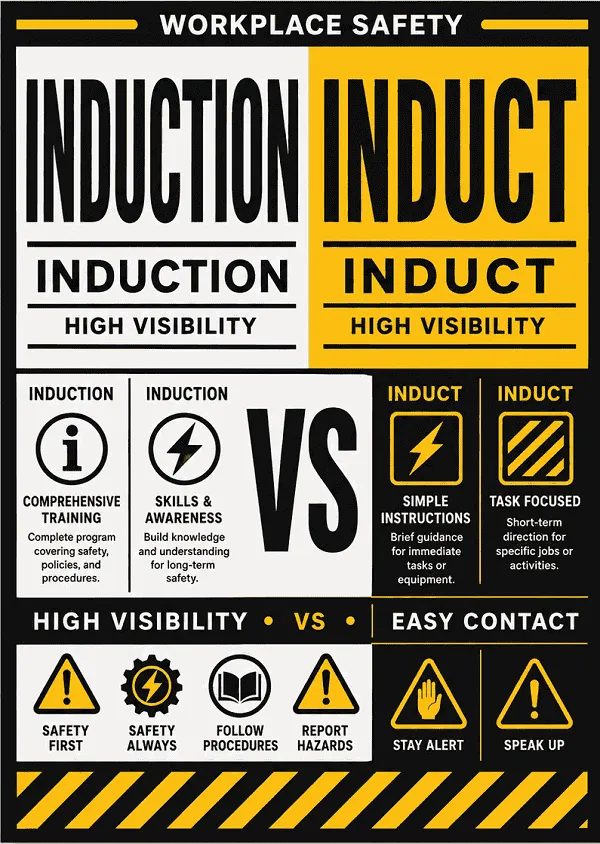
A police check verifies information. Induction prepares people for work.
Assign role-specific induction
Training should match the person’s task, site and access level.
Keep records organised
Forms, acknowledgements, certificates and training records should remain easy to find.
Review requirements regularly
Screening and induction requirements may change when roles, clients, laws or site rules change.
Start improving police-check readiness
Police checks can help employers assess suitability for certain roles before employment, volunteering, contractor work or site access.
They should be handled carefully, with proper consent, privacy controls and role relevance.
Once screening is complete, employers still need a clear way to onboard people, assign induction, collect forms, capture acknowledgements, issue certificates and keep records.
INDUCT FOR WORK helps organisations manage that post-check readiness process through online induction, training, forms, document uploads, reporting and records.
Give new workers and contractors a clearer path from screening to work readiness.
Frequently asked questions
A police check is a process that reviews certain police history information and produces a certificate or result for a stated purpose. A National Police Certificate is sometimes called a national police check.
Employers may request police checks where they are relevant to the role or required for employment, volunteering, licensing, registration or site access. Victoria Police notes that employers, organisations and regulators may request a National Police Certificate to help assess suitability for several purposes.
No. A police check is one type of background check. Broader background checks may include work rights, employment history, qualifications, references, licences and other role-related checks.
No. A police check may support suitability assessment. Induction explains workplace rules, safety procedures, reporting steps and role expectations.
Yes. INDUCT FOR WORK can help with online induction, forms, document uploads, acknowledgements, certificates, training records and reporting after screening has been handled elsewhere.
Employers should store sensitive screening records securely and limit access. Induction, forms, certificates and training records can be managed through a structured online process.
Do you have any questions or great tips to share?
Induct for Work – the only online induction system you would need to run online inductions.
Start a free trial or book a demo to see how INDUCT FOR WORK can support your workplace processes.
Author: Ari Parz
Published: 17/03/2020
Updated: 21/05/2026